Homeowner Design Guidelines

COMMUNITY ASSOCIATION
11411 Southern Highlands Parkway, Suite 100
Las Vegas, NV 89141
702-361-6640 Telephone
HOMEOWNER
DESIGN GUIDELINES
Adopted by the SKYE HILLS Board of Directors
November 10, 2021
Amended January 22, 2024
Amended May 6, 2025
Section 1: Community Overview
1.1 INTRODUCTION
Situated adjacent to the proposed Sheep Mountain Parkway in the northwest Las Vegas valley, SKYE HILLS is designed to provide a graceful transition from the rural development to its south, while respecting the densities and design of the Providence Community. The purpose of the Design Guidelines is to establish the procedures and evaluation criteria for proposed builder neighborhoods within SKYE HILLS, the guidelines described herein establish general concepts and provide the direction for the expression of the built environment within SKYE HILLS. They are intended to provide an overall framework for future development, in order to achieve a sense of community identity, character, scale and sensitivity in the development of SKYE HILLS.
Equally important, an extraordinary amount of time, resources, and capital shall be expended for the development of infrastructure, landscaping and other site improvements, which are integral to the creation of a strong sense of identity for SKYE HILLS. The Design Guidelines are intended to provide a vehicle to protect and maintain the long term quality and value of the community. Accordingly, the Design Guidelines apply to all construction within SKYE HILLS, including new construction, remodels and additions, landscape, signage, and neighborhood amenities.
The sketches and graphic representations contained herein are for conceptual purposes only, and are to be used as general visual aids in understanding the basic intent of the guidelines. They are not meant to depict any actual lot or building design. In an effort to encourage creativity and innovation, the guidelines express "intent" rather than "absolute", thereby allowing certain flexibility in fulfilling the intended design goals and objectives. The authority for determining whether a proposed design or feature of a design shall be acceptable rests with the Declarant ("Declarant") and/or the various review committees it designates.
1.2 Supporting Documents
The Design Guidelines supplement the following documents which must also be consulted during the design and development of individual parcels within SKYE HILLS:
- City of Las Vegas Building Codes
- Master Declaration of Covenants, Conditions & Restrictions for SKYE HILLS (Master CC&R's)
- The Master CC&Rs or any Neighborhood Association, which governs the Lot or Property in question.
1.3 RESPONSIBILITY OF REVIEW
The Board of Directors of SKYE HILLS, the Declarant and/or the ARC (collectively or individually, the "Reviewer") assume no responsibility for plan review relative to the official codes or ordinances. The purpose of the plan review is to ensure that each project meets the intent of the Design Guidelines and Declarations. All projects within SKYE HILLS require review and approval by the Reviewer prior to submittal to the City of Las Vegas or other applicable public agencies.
1.4 PROJECT LOCATION
SKYE HILLS is a master planned community consisting of approximately 1,650 acres in the northwest region of Las Vegas. It is located on either side of US 95 with the primary access from Horse Drive. The community features a variety of land uses and infrastructure improvements that enhance and protect the quality of life for residents and visitors alike.
NOT WITHSTANDING ANY OTHER PROVISION SET FORTH IN THESE DESIGN GUIDELINES, THE FOLLOWING SECTIONS 1.5 THROUGH 1.12 SHALL APPLY:
1.5 DESIGN GUIDELINES
This SKYE HILLS Homeowner Design Guidelines ("Design Guidelines") comprises the "Architectural Guidelines," as said term is referred to in the Master Declaration of Covenants, Conditions and Restrictions and Reservation of Easements for SKYE HILLS ("Master Declaration"). 190 Octane FT Partners, LLC, a Nevada Limited Liability Company ("Declarant") shall have sole and full authority to amend the Design Guidelines during the Declarant Rights Period, as defined in the Master Declaration ("Declarant Rights Period"), unless Declarant also expressly delegates in writing such power to amend. Upon termination or delegation of Declarant's right to amend, the Board of Directors shall have the Authority to amend the Design Guidelines. Any amendments to the Design Guidelines shall be prospective only, and shall not require modifications to or removal of structures previously approved once the approved construction or modification has commenced. There shall be no limitation on the scope of amendments to the Design Guidelines, and such amendments may remove requirements previously imposed or otherwise make the Design Guidelines less restrictive.
1.6 NO WAIVER
The person(s) reviewing applications under the Design Guidelines will change from time to time and opinions on aesthetic matters, as well as interpretation and application of the Design Guidelines, may vary accordingly. In addition, it may not always be possible to identify objectionable features of proposed work until the work is completed; in which case, it may be unreasonable to require changes to the completed work, but the Reviewer may refuse to approve similar applications or proposals in the future. Approval of applications or plans for any work done or proposed, or in connection with any other matter requiring approval, shall not be deemed to constitute a waiver of the right to withhold approval as to any similar applications, plans, or other matters subsequently or additionally submitted for approval.
1.7 "REVIEW" DEFINED
"Subject to review and approval by the ARC" or words of similar import, as used from time to time in these Design Guidelines, shall mean "subject to the requirement of the Applicant at his or her sole cost to submit all necessary documents to the Reviewer for review, and approval or disapproval (denial), in the sole discretion of the Reviewer. No work may or shall be commenced without approval unless stated otherwise in these Design Guidelines." The Declarant or the Board of Directors may establish and charge reasonable fees for review of applications, and may require such fees to be paid in full prior to review of any application. Such fees may include, but are not limited to, the reasonable costs incurred in having any application reviewed by architects, engineers, or other professionals.
1.8 LIMITATION OF LIABILITY
The standards and procedures in these Design Guidelines are intended as a mechanism for maintaining and enhancing the overall aesthetics of SKYE HILLS, but shall create no duty to any person. Review and approval of any application are made on the basis of aesthetic considerations only, and the Reviewer shall have absolutely no liability or responsibility whatsoever for ensuring: (a) the structural integrity or soundness of approved construction or modifications; (b) compliance with building codes and other governmental requirements; (c) that Units are of comparable quality, value, size, or of similar design, aesthetically pleasing, or otherwise acceptable to neighboring property owners; (d) that views from any other Unit are protected; or (e) that no defects exist in approved construction. Neither Declarant, Reviewer, Association, Board, nor any committee member or agent of any of the foregoing, shall be held liable for soil conditions, drainage or other general site work; any defects in plans revised or approved hereunder; any loss or damage arising out of the action, inaction, integrity, financial condition, or quality of work of any contractors, subcontractors, employees, or agents, whether or not such person has been approved as a Builder (as defined and set forth in the Master Declaration) in SKYE HILLS; or any injury, damages, or loss arising out of the manner or quality or other circumstances of approved construction on or modifications to any Unit. In all such matters, the Reviewer, it's members, affiliates, and agents shall be defended and indemnified by the Association as provided in the Master Declaration.
1.9 SCOPE OF REVIEW
The Reviewer shall review and approve or disapprove (deny), all proposals, plans and specifications submitted to it for any proposed improvement, alteration, or addition, solely on the basis of the factors set forth in Section 1.7 above, and solely with regard to the visible appearance of the size, color, location, and materials thereof. The Reviewer shall not be responsible for reviewing, nor shall its approval of any plan or design be deemed approval of, any proposal, plan or design from the standpoint of structural safety or conformance with building or other codes. Each homeowner shall be responsible for obtaining all necessary permits and for complying with all governmental (including, but not limited necessarily to City) requirements. The Reviewer may request copies of such agency approvals.
1.10 DECLARANT AND CERTAIN BUILDERS EXCLUDED
During the Declarant Rights Period: (a) these Design Guidelines shall not apply to activities of Declarant, and (b) the architectural review process may be waived by Declarant, at its option, for a Builder that has duly received Declarant's approval of a project plan pursuant to the process set forth in a recorded Developmental Declaration satisfactory to Declarant.
1.11 JURISDICTIONAL LIMITATIONS
The standards and procedures in this article are intended as a mechanism for maintaining and enhancing the overall aesthetics of the Properties but shall not create any duty to any person. During the Declarant Rights Period, the Board of Directors shall have the authority to designate one or more persons or entities to review submissions on it's behalf as its agent.
1.12 PRE-EXISTING CONDITIONS REQUIRING REVIEW
Any owner having an existing improvement that was not built by the original home Builder, and does not have a written approval letter from the Association requires review. The Owner must file an Architectural Review Application requesting written approval for the existing conditions. This may include, but is not limited to swimming pools, patio covers, landscaping or other built structures. The Association may require copies of building permits for those improvements that require City approval. A pre-existing improvement constructed by current, or prior owners without prior written approval, does not guarantee approval of the existing condition. A pre-existing improvement that does not comply with these Design Guidelines may need to be modified or removed, based on the findings of the review.
1.13 DEFINITIONS
Unless the context otherwise specifies or requires, the following words or phrases when used in this Design Manual shall have these specific meanings. Terms defined in the Declaration shall have the meaning specified therein.
- "Accessory Structure"
- means a structure separate and detached from the primary Dwelling, inclusive, but not limited to play structures, covered barbecues. See also Ancillary Structure.
- "Ancillary Structure"
- means a structure separate and detached from the primary Dwelling, inclusive, but not limited to guest houses pool pavilions, detached garages, detached trellis, etc. See also Accessory Structure.
- "Architect"
- means a person appropriately licensed to practice architecture or landscape architecture in the State of Nevada and who provides "Qualified Design Services".
- "Architectural Guidelines"
- means the architectural, design, and construction guidelines (also referred to as the Design Guidelines) and application and review procedures applicable to the Properties, as promulgated and administered pursuant to Article 4, as may be amended.
- "Architectural Working Drawings"
- means the set of construction documents prepared for submittal to the governing agency for the purpose of obtaining building permits for construction of the proposed Dwelling.
- "Basement"
- refers to that portion of a Dwelling which is constructed underground, and as such, no more than one-third of any exterior elevation can be visible from any property within the SKYE HILLS Community Association.
- "Builder"
- means any Person now or hereafter, as specifically designated by Declarant, who purchases one or more Lots for the purpose of constructing Improvements for later sale to consumers, or who purchases one or more parcels of land within SKYE HILLS for further subdivision, development, and/or resale in the ordinary course of such Person's business. Notwithstanding the foregoing, no person shall be defined as a Builder without the express consent of the Declarant.
- "Common Area"
- means all (i) real property, other than Lots, owned or leased by the Association, which may include entry monumentation, private entry gates and guard houses for the Properties, Private Streets, street lights, street signs, curbs and gutters, landscape areas, and open space areas; (ii) real property over which the Association holds any interest for the use and enjoyment of the Owners, which may include easements designated on a Plat as access and ingress/egress easements, as pedestrian/bike trails or access corridor easements, as landscape easements, as public utility easements, as drainage and/or municipal utility easements, and any other such easements; (iii) any water reclamation system or facilities constructed by Declarant to serve SKYE HILLS; (iv) any personal property owned by the Association for the use and enjoyment of the Owners; and (v) any other property owned or held by the Association for the use and enjoyment of the Owners including, but not limited to, entry monumentation, street lights, street signs, curbs and gutters, landscaping and all perimeter walls or fences Declarant constructs surrounding the Properties or which separates a Lot from an Area of Common Responsibility. Notwithstanding the foregoing, all Private Amenities are separate and constitute private property, and are NOT A PART of the Common Elements, are NOT A PART of the Properties.
- "Declarant"
- means 190 Octane Partners, LLC, a Nevada limited liability company, or any successor, successor-in-title, or assign who takes title to any portion of the Properties subject to this Declaration or to any part of the property described in Exhibits "A" or "C" of the C. C. & R's for the purpose of development and/or sale, and who is designated as Declarant in an express Recorded assignment executed by the immediately preceding Declarant (but specifically excluding Purchasers as defined in NRS Chapter 116).
- "Declarant Control Period"
- means the period of time during which Declarant is entitled to appoint and remove one or more members of the Board of Directors under NRS Chapter 116. The Declarant Control Period shall terminate one hundred and twenty (120) days following the last day of the Declarant Rights Period, or such earlier date as may be require by operation of NRS Chapter 116. Nothing in this Section shall preclude Declarant, in its sole discretion, from voluntarily relinquishing control of the Board earlier than required by this Section, and in such event, Declarant reserves the right to veto actions of the Association as provided in the Bylaws until such time as the Declarant Control Period would have otherwise expired under this Section.
- "Declarant Rights Period"
- means the period of time during which Declarant (or any of its affiliates) owns or has the right to acquire any property subject to the Declaration or that may become subject to the Declaration by annexation in accordance with Section 9.1 of the C. C. & R.'s, and during which period of time, Declarant has reserved certain rights as set forth in the Declaration.
- "Design Guidelines"
- means the restrictions, review procedures, and construction regulations for any Improvements within SKYE HILLS Community Association as adopted and enforced by the Reviewer. These criteria, as set forth herein, may be duly amended or supplemented by Declarant or Board of Directors from time to time.
- "Design Professional"
- means an individual who has demonstrated competency in the site analysis, planning and technical knowledge in an environment with similar opportunities and constraints as are common in The SKYE HILLS Community Association. A Design Professional must be licensed in the State of Nevada per NRS.
- "Dwelling"
- means a single Family detached residential building located on a Residential Lot (but not a Multi-Family Lot), or, in a condominium, a condominium unit, designed and intended for use and occupancy as a residence by a single Family, but specifically excluding "manufactured housing" or mobile homes, neither of which shall be permitted as Dwellings.
- "Excavation"
- means any disturbance of the surface of the land (except to the extent reasonably necessary for planting of approved vegetation), including any trenching which results in the removal of earth, rock, or other substance from a depth of more than twelve inches (12") below the existing surface of the land or any grading of the surface.
- "Existing Grade"
- is the existing contour of a home-site, prior to the time any alterations, grading, or site work is done to the Lot.
- "Fill"
- means any addition of earth, rock, or other materials to the surface of the land, which increases the existing elevation of such surface.
- "Front Yard"
- means the portion of a Residential Lot that is the area between the plane formed by the exterior of the front facade of the Dwelling and outward to the back of the curb of the Residential Lot or if the curb is not located on the Residential Lot then the front lot line.
- "Governing Documents"
- is a collective term referring to the Declaration and any applicable Supplemental Declaration, the Articles, the Bylaws, the Design Guidelines, and the Rules and Regulations, as they may be amended.
- "Improvement"
- means any structure or appurtenance thereto of every type and kind, whether above or below the land surface, placed in the Properties, including, but not limited to, Dwellings and other buildings, walkways, sprinkler pipes, swimming pools, spas and other recreational facilities, carports, garages, roads, driveways, parking areas, hardscape, Private Streets, streetlights, curbs, gutters, walls, perimeter walls, fences, screening walls, block walls, retaining walls, stairs, decks, landscaping, antennae, hedges, windbreaks, patio covers, railings, plantings, planted trees and shrubs, poles, signs, exterior air conditioning, and water softener fixtures or equipment.
- "Light Reflective Value (LRV)"
- is the reflectivity of a surface measured by a calibrated light meter. The value of 100 percent represents the percentage of light reflected from a space-pure white; flat black will equal a value of 0 percent.
- "Lot"
- means a Residential Lot, a Multi-Family Lot, a Mixed-Use Lot, or a Commercial Lot. As defined herein, the term Lot shall not include any part of the Private Amenities.
- "Lot Survey"
- means that information obtained through an engineer depicting existing features, inventory, and Lot configuration.
- "Master Association"
- means SKYE HILLS Community Association, a Nevada non-profit corporation, its successors or assigns. The rights and duties of the Master Association are as set forth in the Declaration.
- "Minor Modification"
- means a change to the Building Envelope in any outward direction. A variance shall be required.
- "Neighboring Lot Visibility"
- shall mean, any given object or activity that is or would be visible without artificial aids from 6 feet above any other Lot of similar elevation or any Common Area of similar elevation.
- "Neighborhood Association"
- means homeowners' association, created by Supplemental Declaration, having subordinate, concurrent jurisdiction with the Association over its own specific Neighborhood. Nothing in the Declaration shall require the creation of a Neighborhood Association for any Neighborhood.
- "Open Space"
- means all land, Improvements, and Common Areas now or hereafter designated as such on the Plat, or the Declaration or the Association Rules.
- "Owner"
- means the Person or Persons, including Declarant, holding fee simple interest of Record to any Unit. For the purpose herein, the Owner may act through such Owner's agent provided that such agent is authorized in writing to act in such a capacity.
- "Party Wall(s)/Fence(s)"
- means the walls and/or fences located generally on the property line of a Unit, as set forth but not including Perimeter Walls/Fences.
- "Perimeter Wall(s)/Fence(s)"
- means the walls and/or fences, initially constructed by Declarant, and located generally around the exterior perimeter of the Development.
- "Rear Yard"
- means the portion of a Residential Lot that is the area between the plane formed by the back facade of the Dwelling and the rear lot line.
- "Reviewer"
- means the an architectural reviewer appointed by Declarant, and (b) from and after the expiration of the Declarant Rights Period, the Board and/or an architectural review committee appointed by the Board but only to the extent that the Board shall have delegated the responsibilities for architectural review to such committee.
- "Screen Wall"
- means any wall installed by the Owner, other than a Party Wall, installed for the purpose of screening any exterior ground-mounted mechanical or pool equipment from view of street, common area, or adjacent Lot.
- "Side Yard"
- means the portion of a Residential Lot that is the area between the plane formed by the exterior of the side facade of the Dwelling (between the front facade and rear facade of the Dwelling) and outward to the side lot line, plus the area of any private use easement benefitting such Residential Lot that the Owner of the Residential Lot is required to maintain.
- "Structure"
- means anything constructed or erected on a Lot, the use of which requires location on the ground or attachment to something having location on the ground.
- "Unit"
- means the residential portion of the SKYE HILLS Community to be separately owned by each Owner (as shown and separately identified as such on the Plat, subject to the portion of Private Street located on an easement over a portion of the Lot), and shall include a Lot and all Improvements thereon (which, with regard to a Perimeter Unit, shall specifically include the Unit Wall/Fence, pursuant to this Declaration.
Section 2: Residential Site Planning
2.1 RESIDENTIAL DEVELOPMENT STANDARDS MATRIX
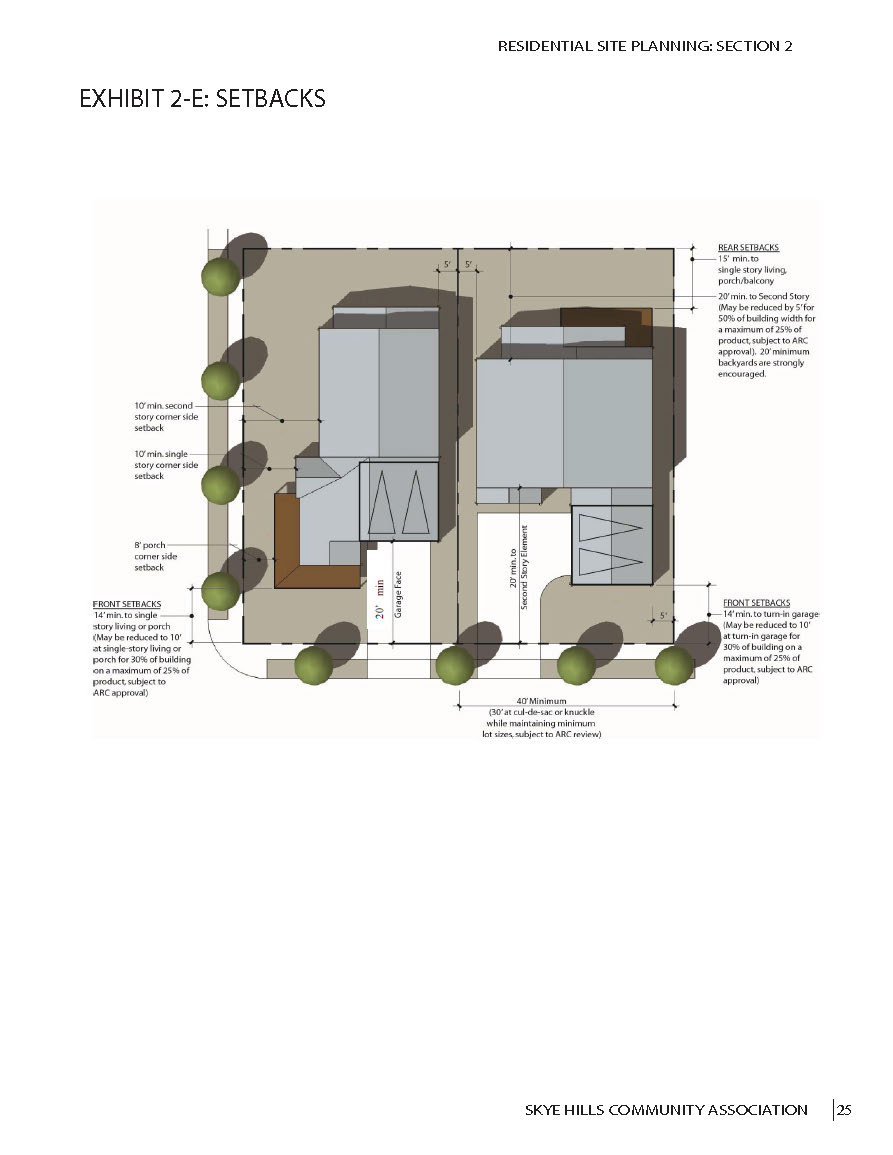
Refer to Exhibit 2-A for all setback criteria.
2.2 SETBACK EXCEPTIONS
2.2.1 PROJECTIONS
Architectural elements such as eaves, cornices, canopies, sills, bay windows, chimneys, media niches and other similar elements may project a maximum of 3 feet into required front or side setback areas, however in no case shall such projection be closer than 3 feet to any property line.
2.3 WALLS, FENCES & GATES
All wall and fence construction, extensions, and finish materials not installed as part of the original construction of the residence by the Builder.
2.3.1 FRONT YARD WALLS
Courtyard walls are permitted within front yards. Refer to Exhibit 2-A for setback requirements.
2.3.2 CORNER SIDE YARD WALLS
On corner lots, walls and fences shall terminate a minimum of 4 feet back from the front façade of the residence and tie back into the residential structure.
2.3.3 REAR YARD WALLS
Some lots adjacent to community open space feature tubular steel fencing installed by the builder along the rear property line and returning approximately 15 feet along each side property line. A field of vision exists for these lots and is determined by establishing a point 15 feet from the property corner along the rear property line and another point measured 15 feet from the property corner along the side property line. The imaginary line connecting these two points forms the field of vision.
Landscape improvements within the field of vision are limited to turf, ground cover or other low elements less than 12 inches high.
2.3.4 ACCEPTABLE MATERIALS
Where a wall or fence is visible from any street or community open space, it shall have a masonry finish compatible with the existing walls throughout the community or compatible with the architecture of the house. Acceptable wall materials include textured finish concrete block, split face masonry and painted wrought iron. Smooth block shall not be visible to the street or common areas.
2.3.5 WALL SPECIFICATIONS
All property line walls must be water-proofed when retaining and must be properly maintained. Refer to Exhibit 2-D for water-proofing standards.
Owners cannot modify existing property line walls without prior written approval from the Reviewer. In any case, an existing wall shall not be modified to exceed more than 6 feet measured from highest adjacent finished grade. Any modification to an existing wall, or addition of a new wall requires review and approval.
The architectural submittal must include (other information may be requested):
- A plan showing location of proposed change
- Color photos of existing wall(s)
- Shared wall consent form
- Structural engineering showing existing wall can support addition of new block.
- Water-proofing material shall be indicated at any retaining condition. A Delta waterproofing system detail must be installed, and details shall be reviewed and approved prior to installation. The water-proof material must extend a minimum of 4" above adjacent finished grade.
A permit from the governing agency must accompany a request for a fence exceeding 24 inches in height. Verify permitting requirements with City of Las Vegas. The Owner is responsible for obtaining all applicable permits and inspections.
Decorative arches, single and double gates require written approval of the Reviewer. Refer to Section 2.3.7.
2.3.6 PROHIBITED WALL, FENCE OR GATE MATERIALS
- Unfinished slump block walls
- Wire Fencing
- Stucco finish on exterior of perimeter walls
- Vinyl Fencing
- Metal or nylon coated chain link
- Sharp Spikes
- Standard gray or painted concrete block walls
- Plastic or fiberglass panels
- Plastic webbing, reeds or bamboo
- Glass block and panels
- Woven bender board
- Wood Fencing
2.3.7 GATES
All gates must be constructed of wrought iron. Applications for gate installation must indicate that the gate(s) will be constructed according to the following:
- Square tubular iron materials
- Spacing per governing agency ordinance
- The height of the gate shall not exceed 6'-2". The height shall be equal to or less than the adjacent wall.
- Maximum width of a gate panel is 52".
- Coloring of gate shall match or compliment that of residence (body color, trim or accent).
- Screening of metal mesh painted to match the gate.
Solid Gates/ Solid Gate Panels:
A "Solid Panel" is defined as any gate panel that has a predominately solid surface without significant openings or breaks or as any wrought iron gate panel that has a solid screening behind tubular posts.
Any owner having an existing gate with solid panels that does not have a written approval letter from the Association must file an Architectural Review Application requesting review and approval for the existing gates.
Any proposed solid gate must be submitted for review. Submittal must include placement, size, color, type, and location. The solid paneled gate specifications are as follows:
- The width of one Solid Panel may not exceed 52 inches
- No gate, including panel, may exceed 6'-2" in height at any point
- The frame of the gate must be square tubular material of iron or steel
- The Solid Panel must be attached to the frame
- All Solid Panel installations must be completed in accordance with all applicable codes
- The color of the gate, including panel, body, trim, post, and/ or accent must compliment or match the color of the applicable residence. Determination of whether or not a color compliments the residence is at the sole discretion of the Reviewer
2.4 GRADING
2.4.1 LOT GRADING
Finish grading to accommodate new construction or site development shall be the responsibility of the homeowner. In addition, it shall be the homeowner's responsibility to meet existing grades at all perimeter property lines. Any finish grading shall maintain smooth slope transitions between lot grading and surrounding development or open space. The cost of such grading is the responsibility of the homeowner.
Grading and other lot improvements shall not negatively impact community open space with dust, over-spray, over-excavation, trespass, noise, or other similar construction activities.
2.4.2 RETAINING WALLS
Maximum wall height shall be 9 courses as measured from adjacent finished grade. Local governing agency permit required for any wall exceeding 24 inches in height.
On corner lots at neighborhood entries, the maximum height of a retaining wall abutting a curb or sidewalk is 4 feet. Such retaining wall must be a minimum of 10 feet from property line per matrix in Section 2.1.
Grade changes that require retaining walls exceeding 4 feet must be terraced with a minimum of 3 feet separation between each wall. All retaining walls must be waterproofed and adequately drained. Please refer to Exhibit 2-D.
2.4.3 SLOPE STABILIZATION
Slopes shall not exceed 3:1 (one foot vertical to three feet horizontal) on a single family lot. All temporary slope banks greater than 3:1 shall be treated with slope erosion control materials. Permanent slopes shall be landscaped and irrigated with an automatic irrigation system and stabilized with erosion control mats, if necessary. No overhead irrigation on slopes 3:1 or greater.
2.5 DRIVEWAYS
2.5.1 DRIVEWAY MATERIAL
Driveways shall be pavers material to match the original driveway installation. Any modification of the original pavers requires review and approval. Pavers are the only approvable driveway material.
2.5.2 MAXIMUM WIDTH OF DRIVEWAYS
Driveway width shall not exceed the width of the exterior garage walls.
Prohibited:
- Driveway extensions to access side yard recreational vehicle storage areas are prohibited.
2.6 SITE AMENITY STANDARDS
2.6.1 ACCESSORY STRUCTURES
Accessory structures such as detached garages, equipment enclosures, gazebos, trellises, cabanas, storage and utility sheds, etc., not a part of the principle structure. Such structures must be designed to match or compliment the residence in materials and architectural style. Such structures may be visible from a street or common area, provided non-deciduous landscape materials are installed to minimize the visual impact. All landscaping installation must be reviewed for compliance with Section 4 of this manual. Impacted Neighbor Statements must be submitted. Please refer to Section 2.1 for setback criteria.
Prohibited:
- Open sided structures such as Palapas and Tiki-Huts with natural straw, woven, or thatched roofing materials.
2.6.2 STORAGE AND UTILITY SHEDS
Commercial pre-fabricated movable storage sheds or bins that have a maximum dimension of 6'x8'x6' (tall) are pre-approved and do not need to be submitted for review. Storage sheds or bins exceeding these dimensions are subject to the requirements of Section 2.6.1 and must meet the following requirements:
Minimum Setback:
- 5 feet from side or rear property lines
Material:
- Tile roof to match house. Exterior color must match house.
Screening:
- Non-Deciduous Landscape screening required to screen equipment from street, community open space, and neighboring lots, unless the walls are finished with stucco to match the house.
Prohibited Materials:
- Asphalt composition roofing
- Flat Concrete Tile
2.6.3 SWIMMING POOLS
Waterfalls and other features may not be built against a property line wall. Any installation of water features must comply with the City of Las Vegas Environmental Standards. Pool and spa equipment must be screened from view of any street, community open space, or adjacent lot through the use of a solid wall to match the property line wall. Landscape material can be considered for screening, but requires review prior to installation.
If the lot size and configuration requires that the pool and spa equipment be placed in the side yard of the residence between a property line wall and the residence and a solid wall cannot be constructed in a manner that permits safe passage through the side yard, then an Owner may be permitted to screen the pool and spa equipment from view with mature, non-deciduous trees or shrubs that fully, completely and constantly block the view of the pool equipment from any street, community, open space or adjacent lot.
All pools and spas must be constructed according to the required setbacks, fence and enclosure heights. See Exhibit 2-B. Access for equipment used in construction must be over or through the applicant's property. Building equipment and materials must be contained on the applicant's property. Streets shall not be obstructed with equipment or building materials. Impacted Neighbor Statements must be submitted.
Prohibited:
- Access is not permitted through or over a main perimeter wall.
- Pools may not feature decorative water features that drop or propel water more than 24 inches above the main water surface.
2.6.4 SPORT COURTS
Sport courts must meet the following minimum criteria:
- 10 foot minimum setback from property line walls
- Non-deciduous landscape screening to screen courts from view from streets, community open space, and neighboring lots. Location and species must be identified.
- Lighting, if installed, located, directed and shielded so that light rays and glare to the greatest extent practical, do not extend beyond the lot boundaries.
- Impacted Neighbor Statements must be submitted.
2.6.5 PLAY EQUIPMENT
Approval is not required for commercially constructed swing sets and jungle gyms that will be placed in the rear yard, so long as they are not higher than any portion of the property's rear yard fence and are adequately screened from view by a gate or landscape material. Pre-existing play equipment is subject to these criteria and review requirements.
2.6.6 OTHER TYPES OF PLAY EQUIPMENT
Play equipment not defined in Section 2.6.5 above, including, but not limited to, large swing sets, gymnastics, and climbing apparatus structures shall include the following criteria with the application for review:
- Max. Height: 9 feet
- Minimum Setback: 10 feet from any property line
- Material: Wood, painted similar to house color, trim or accent (no bright colors)
- Screening: Non-deciduous landscape screening required to screen equipment from street, community open space, or neighboring lots.
- Impacted Neighbor Statement: Required
2.6.7 EXTERIOR SITE LIGHTING
Any changes or additions to exterior, landscape, accent, decorative or other lighting not installed by the Builder shall comply with these Design Guidelines. Architectural Review is required.
Lights that are permanently attached under the eaves of the roof, on the ground shining up towards the house, or in another location must adhere to the following guidelines:
- Light colors may be seasonally appropriate during holiday decoration time frames, as defined in the Rules and Regulations.
- During all other times of the year (non-holidays), only natural/neutral colors may be displayed. Lights must be either a warm white (no more than 2,800 Kelvin) or a soft white (no more than 3,500 Kelvin). No flashing or color changing may occur, except during holiday time frames.
- The lights may only be turned on from dusk to dawn.
- The structure of the lights (light bulbs, fixtures, fasteners, connectors, etc.) may not be visible from the street.
Lighting must be directed away from streets, community open space and adjacent lots. All exterior lighting must provide for significant shielding to ensure that light sources and lamps are not visible from adjacent lots.
Prohibited:
- Decorative colored lighting.
Exception: When displayed as holiday lights as defined in the Rules and Regulations.
2.6.8 FLAG POLES
Owners are responsible for complying with the requirements of the Federal Flag Code.
A site plan showing location, height, color of pole, size and type of flag shall be provided with the Application for review.
Exhibits - Section 2
EXHIBIT 2-A: RESIDENTIAL DEVELOPMENT STANDARDS
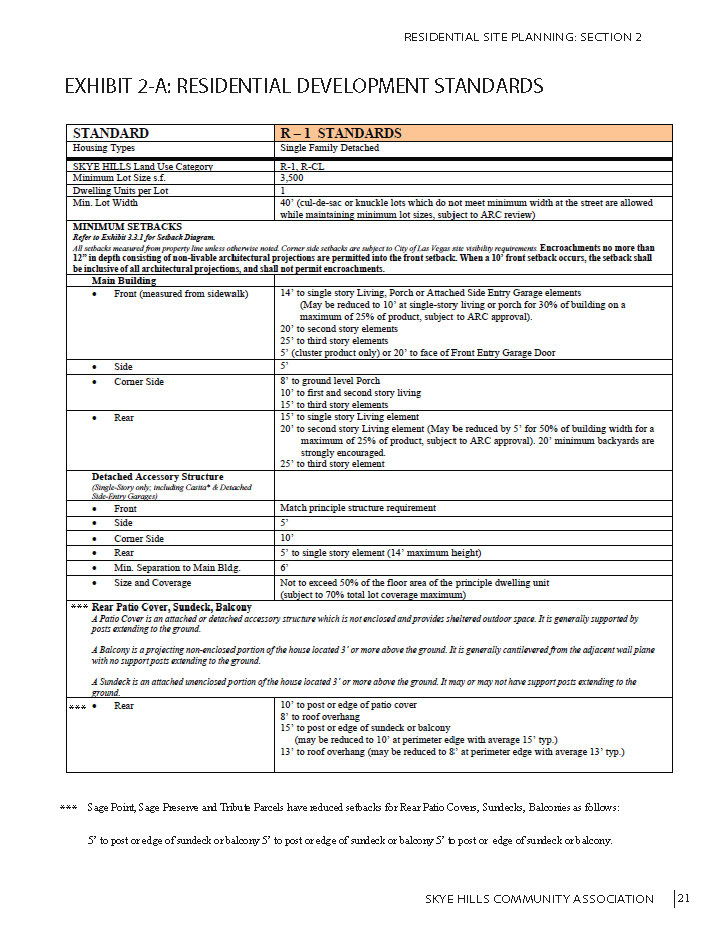
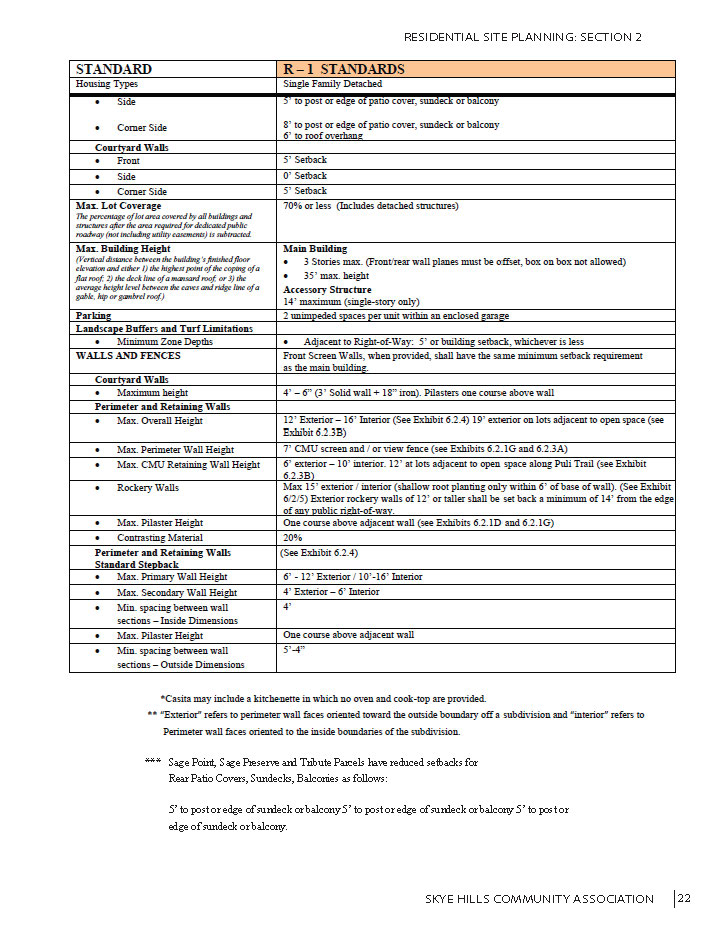
EXHIBIT 2-B: SWIMMING POOL SETBACKS
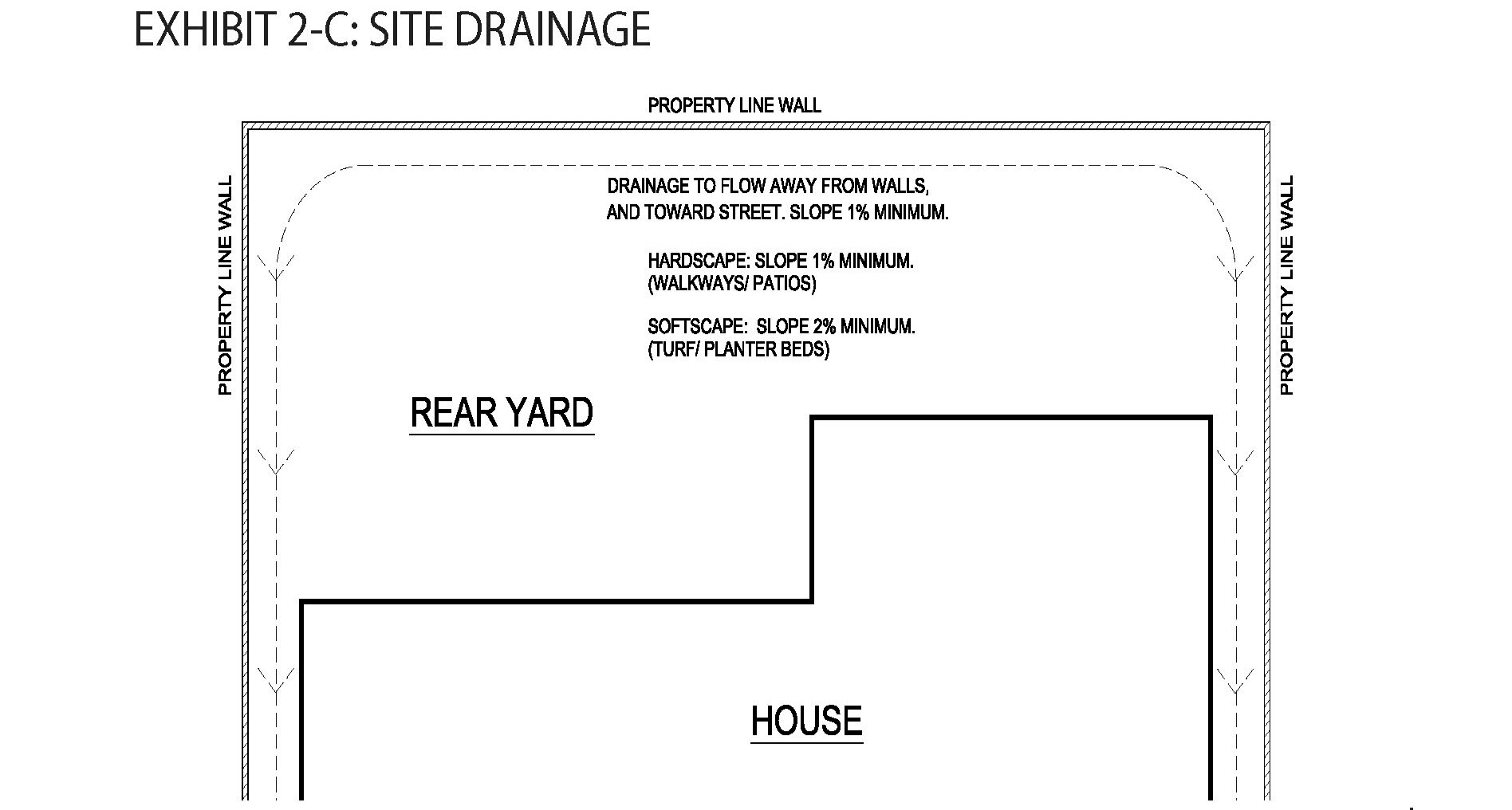
EXHIBIT 2-C: SITE DRAINAGE
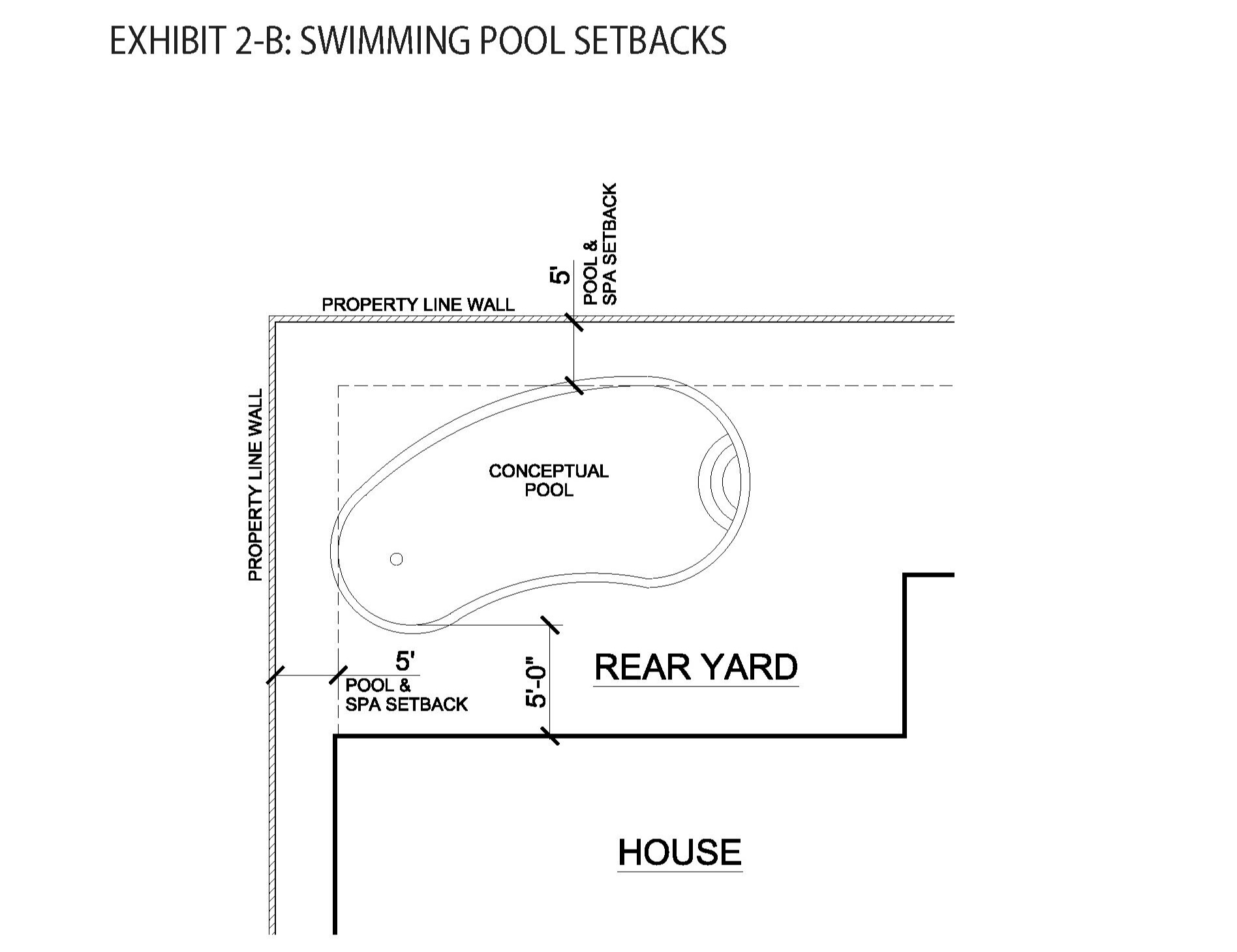
EXHIBIT 2-D: RETAINING WALLS
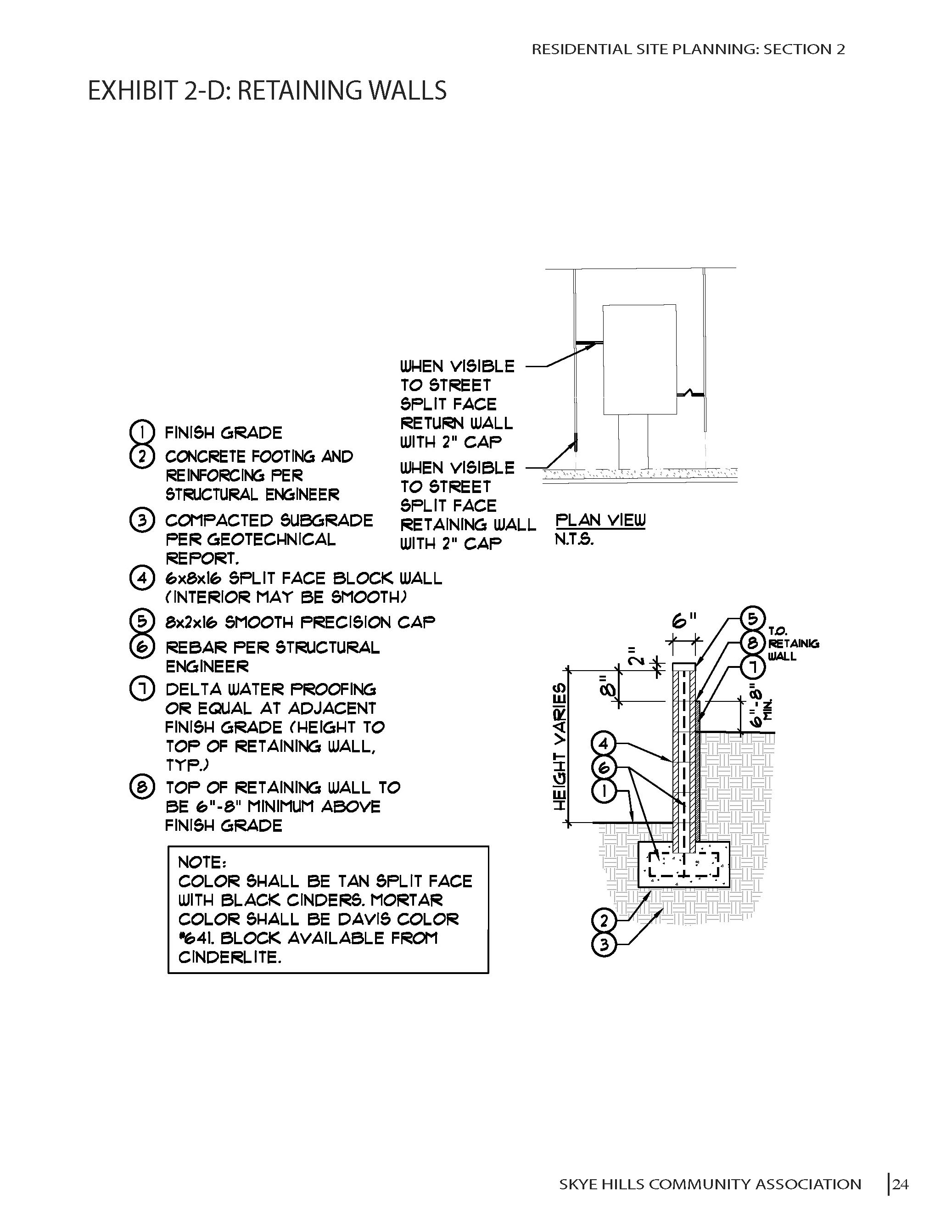
EXHIBIT 2-E: SETBACKS
Section 3: Architectural Character and Theme
3.1 ARCHITECTURAL CHARACTER AND THEME
The Design Guidelines establish the framework to achieve harmony and compatibility within the residential neighborhoods, while providing the flexibility to create variety in the architectural expression and interpretation of the style envisioned for the community.
Any room additions, casita structures, and modifications to an existing dwelling shall comply with this section. This section discusses the requirements for a variety of architectural and site amenities and the related requirements.
Architectural styles within Skye Hills are defined as Andalusian, Italian, Mediterranean, Nevada Living / Rustic Contemporary, Spanish Colonial, and Tuscan.
3.2 ARCHITECTURAL COMPONENTS
The architecture of a residence can be broken down into three major components, including 1) Building Facades, 2) Roofs, and 3) Architectural Features & Accents. The proper design treatment of these three components will result in a visually pleasing house and neighborhood environment throughout Skye Hills. The following is a general description of each of these components should be addressed relating to the Skye Hills themed architectural style.
3.3 BUILDING FACADES
Architectural improvements should be carefully designed to ensure that they are well integrated and consistent with the architectural character of the existing residence, its site and surrounding context. Variety in building forms is encouraged to provide diversity and visual interest to the neighborhood street scenes throughout Skye Hills.
3.3.1 BUILDING MATERIALS AND COLOR
The primary wall surfaces for the architecture generally feature a stucco finish. In order to enhance the variety of the neighborhood street scenes, additional accent materials, such as stone or brick should be used as accent materials.
3.3.2 VENEER MATERIALS
All surface treatments or materials should be designed to appear as an integral part of the design, and not merely applied. All materials should wrap columns, porches, or balconies in their entirety.
Material changes shall terminate to inside corners. Materials applied to any elevation shall turn the outside corners of the building a minimum of 2 feet before terminating. This includes stone or brick veneer. Any added veneer materials require review and approval prior to installation. Stone veneer shall not terminate on an outside corner.
3.3.3 EXTERIOR PAINT COLOR
Any change in color from the original exterior colors and/ or materials of any residence or any other improvement must be reviewed and approved. Submittal of color samples of any paint or stain is required when they deviate from the original colors of the residence. Scanned or computer-generated colors are not acceptable for review. Photos of the current residence shall accompany the review submittal.
3.4 ROOF DESIGN
3.4.1 BUILDING MASSING & SCALE
Variety of roof design is encouraged to provide diversity and visual interest to the neighborhood roofscape of Skye Hills.
Roof pitches are typically low pitched (3 ½ :12 to 5:12), often extending over porches or arcades. The use of flat roofs is PROHIBITED. Flat roofs at patios installed previously by the Builder of the neighborhood are the only exception.
Overhangs should range from 12 to 24 inches. Tight fascias will be permitted on gable or rakes (shed) ends only.
3.4.2 ROOF MATERIALS
The accepted roof materials in Skye Hills include concrete barrel tile roofs. Fascias may be either stucco or wood. If wood is used, it shall be stained or painted to match the primary residence
Permitted Roof Materials:
- Concrete barrel tiles that match the original house
- Standing Seam metal roofs as an accent material
- Flat concrete tiles
Prohibited roof materials include:
- Asphalt Shingles
- Fiberglass Shingles
- Simulated Tile including Fiberglass or Metal
- Rolled roofing material
- Dormer style roof vents
- Built-Up Roofing
3.4.3 SKYLIGHTS
Skylights are permitted, but should be designed as an integral part of the roof. Skylight framing material shall be bronze anodized or colored to match the adjacent roof.
Prohibited:
- White domed skylights
3.4.4 MECHANICAL EQUIPMENT
Mechanical equipment such as air conditioners, heaters, evaporative cooler, television and radio antennas and other such devices are not permitted on any roof. Mechanical devices such as exhaust fans, vents and pipes shall be painted to match adjacent roof surfaces.
Any exterior air conditioning equipment other than the equipment installed as part of the original residence must be reviewed and approved. Proposed evaporative coolers and window mounted air conditioning units shall not be visible from the street, community open space or neighboring lots, and shall not extend above the height of the property line wall. New condenser units shall be installed behind the return walls in side yards, and shall not be visible to the street.
3.4.5 SOLAR PANELS and EQUIPMENT
The use of solar panels, hot water storage systems, or other similar devices are permitted. Any wires, conduit or materials used to fasten these devices to the dwelling must be securely fastened. These materials must be painted to match the adjacent wall color. All efforts must be made to minimize visibility to the street and common areas. Installation of "Bird Stop" screening will be required around all roof top solar arrays. (See Exhibit 3-B: Solar Panel Protection).
Solar panels are to be integrated into the roof design, preferably flush with the roof slope, but parallel is acceptable. Frames must be colored to complement the roof. Mill finish aluminum frames are prohibited. Support solar equipment shall be enclosed and screened from view.
Photo-Voltaic roof tiles shall conform to the following criteria:
All conduit line sets shall be integrated into the design of the home. Any exposed conduit shall be painted to match adjacent wall surface.
Prohibited:
- Windmills
- Roof mounted water heaters
- Pole mounted equipment
3.4.6 SATELLITE DISHES
Satellite dishes are permitted subject to the provisions of the Declaration. Architectural review is not required.
Any wires or materials used to connect satellite dishes to the dwelling must be securely fastened, and painted to match the adjacent wall color. Satellite dishes shall not be installed on any property line wall. All efforts shall be made to minimize view of satellite dish to street and adjacent neighbors.
3.5 ARCHITECTURAL FEATURES AND ACCENTS
3.5.1 PERIMETER EDGE CONDITIONS
Any room additions, casita structures, and modifications to an existing dwelling shall comply with this section.
On lots adjacent to perimeter streets, open space or other public areas, side and rear elevations that face such areas should be articulated to provide visual interest to the edge condition. Particular consideration should be given to the treatment of 2nd stories and roof elements.
- Patio Covers and 2nd Story Decks
- Pop-Outs / Bay Windows
- Principal window treatments
- Shutters on 2nd story windows
- Headers, sills or full trims on 2nd story windows
- Introduction of accent building materials and colors
- Introduction of accent elements such as clay vents, out-lookers, and decorative grille work
- Other similar features which provide articulation to the elevation
Articulation to visible side and rear elevations along perimeter areas may be achieved through the use of elements such as:
- Introduction of accent building materials and colors
- Introduction of accent elements such as clay vents, out-lookers, and decorative grille work
- Other similar features which provide articulation to the elevation
3.5.2 ENTRIES
Building entries are often emphasized through the use of recesses, archways, pilasters, columns, or patterned tiles.
3.5.3 PORCHES
Porches and balconies, when provided, shall be designed as an integral component of the building's architecture, compatible in scale and materials.
3.5.4 COLUMNS, ARCHWAYS AND ARCADES
The use of columns, arches, and arcades add articulation to the residence and are characteristic of the various architectural styles within SKYE HILLS. Columns and archways should be scaled appropriately to provide a sense of strength and support.
3.5.5 TRELLIS AND ARBORS
Trellises and arbors must be designed to compliment the style of architecture of the home. The material shall be suitable to maintain their appearance with the climatic conditions of Las Vegas. Unpainted, raw wood materials is not approvable.
3.5.6 COVERED BALCONIES, DECKS AND PATIO COVERS
The use of covered balconies, decks and patio covers provide an excellent opportunity for additional visual interest to the building facade. Such structures must be designed as an integral component of the architecture of the residence, compatible in scale, color and materials.
Preferred materials for patio covers are wood or stucco finish. All natural wood surfaces must be finished with stain or paint. The use of detail elements to match the existing residence are required. The following roofing materials are recommended.
- Wood (stained or painted)
- Concrete roof tile to match the residence
- Aluma-Wood type of material.
Post / Column minimum sizes shall be: (Refer to Exhibit 3-A)
- Wood support posts: 4" x 6"
- Stucco support posts: 10" x 10"
- Aluma-Wood support posts: 4" x 6"
A dimensioned site plan, floor plan, exterior elevations, colors and materials must be included with the submittal. The Impacted Neighbor Statements must also be submitted.
Prohibited materials for balconies and patio covers include the following:
- Plastic or fiberglass
- Plastic webbing, bamboo, reed, woven bender board
- Composition shingles
- Wood shingles
- Flat or low-sloping pitched roof with tile edging.
- Exposed galvanized metal anchors and bracing materials.
3.5.7 WINDOW AND DOOR OPENINGS
Any room additions, casita structures, and modifications to an existing dwelling shall comply with this section.
Front elevations shall feature a principal window treatment, incorporating at least one of the following:
- Principal window having the appearance of being recessed into thickened walls or projected forward of the wall plane.
- Prominent arch element or other decorative window design.
- Headers, Sills or Trim surrounds.
- Use of shutters or other decorative ornamentation
- The use of bay windows on the front facade when appropriate.
- Combination of the above or any other design treatment which achieves the scale, order, proportion or depth of opening which is compatible with the architectural style of the residence.
Window shapes should be appropriate for the architecture of the residence. Arched and stacked window designs are encouraged.
Windows may be either divided light, plain glass, or glass block. Frames may be white, bronze or earthtone colors. Standard gray mill finish frames are prohibited.
Aluminum or vinyl extruded frame windows shall match the house or trim material. Any window that is added to a house must be the same type of frame, color, and material as the existing windows, and requires ARC review and approval prior to installation.
Prohibited:
- Iron bars are not permitted at any window or door openings.
3.5.8 ROOM ADDITIONS and REMODELS
All requirements pertaining to setbacks, exterior finishes and roof material/design as defined in these Design Guidelines shall be followed. Impacted Neighbor Statement is required.
Prohibited:
- Conversion of a Garage into living space, or space other than vehicle storage.
- Conversion of patio covers or balconies into living spaces is prohibited. The existing outdoor living space square footage must remain.
3.5.9 WINDOW TINTING
Original manufactured window glazing is permitted and does not require approval.
Non-reflective tinting is permitted. The color must be compatible with color scheme of house, shall not be a distraction from the exterior appearance of the house. The purpose the tint is serves shall be to minimize UV rays into the house. A color photo of the house with the tint sample must accompany the application. All window locations for tint installation must be indicated.
Prohibited:
- Applied reflective tinting and mirrored glass
- Tinting only one window on a side of the house is not allowed.
- Black-out tint is not allowed
3.5.10 SOLAR SCREENS
Frames must match the existing window frames of the residence. A sample of the screen, frame color, location of screens, and color photo of the house must accompany the application. The color of the screen material shall complement the house.
3.5.11 ROLADEN SHUTTERS
Roladen Shutters or similar rolling shutters require review prior to installation. The proposed location, size, color and style are required for review.
3.5.12 SCREEN AND SECURITY DOORS
Screen doors and Metal Security Doors must be colored to match or complement the residence door and/or the base color. Provide the color, style and manufacturer specification or photograph of the proposed door. Include a color photograph of the existing front door.
3.5.13 DETAIL ELEMENTS
The use of detail elements such as decorative grille work, shutters, tiles, small balconies and balustrades, decorative stucco or clay vents, exposed rafter ends and cross-beams, and other similar elements may be used to complement the architectural style.
Prohibited:
- Iron bars are not permitted at any window or door openings.
3.5.14 RAIN GUTTERS AND DOWNSPOUTS
Exposed downspouts shall be colored to match the surface to which they are attached. Applications for the installation of new rain-gutters and downspouts shall include the location of proposed downspout, color and style of gutters with the application. Include photos of the existing house showing the proposed rain gutter and downspout locations.
3.5.15 WALLS AND FENCES
Walls and fences which are visible from streets, open space, or other public areas, shall be compatible in material, color, and design with adjacent architectural elements. Refer to Section 2.3.
3.5.16 GARAGE DOORS
Garage doors shall be compatible with the design of the residence. In order to avoid the impact of garage doors, it is required that they be appropriately treated with decorative relief cuts, panels, small decorative windows, etc. All garage doors must be recessed a minimum of 8 inches from the adjacent wall plane. Damaged garage door panels must be replaced and match the original door design, texture, paint finish.
3.5.17 CHIMNEYS
Chimneys, when used, should be simple in design, so as not to distract from the building, and should be compatible with the architectural style of the home.
Prohibited:
- Exposed metal flues.
3.5.18 AWNINGS
The use of awnings adds articulation to the character of the residence and is encouraged where appropriate to the architectural style. The design, location, and color of awnings should be compatible with the residence.
Prohibited:
- Metal awnings are prohibited except for Bermuda style shutters.
3.5.19 EXTERIOR BUILDING LIGHTING
The level of on-site lighting as well as lighting fixtures, shall comply with any and all applicable requirements and policies of the City of Las Vegas. Energy conservation, safety and security should be emphasized when designating any lighting system.
Lighting fixtures should be compatible with the style of architecture of each individual house. Maximum wattage: 100 watt for any exterior fixtures. The use of LED fixtures is preferred.
Flood lights shall not be directed toward street or adjacent neighbors or common areas.
3.5.20 SECURITY CAMERAS
Location, color, size, and direction of camera are required. Cameras must be installed in an inconspicuous location, and shall not exceed 8 inches in height or width. Camera color must match adjacent wall surface. No exposed conduit or wire is permitted.
Prohibited:
- Goose-neck style anchoring is not allowed.
3.5.21 ADDRESS PLAQUES
Address plaques must be back-lighted and incorporate photocells for automatic illumination during non-daylight hours. Landscaping must be maintained so that address plaque is visible 24 hours a day.
Exhibits - Section 3
EXHIBIT 3-A: PATIO COVERS - REQUIRED COLUMN SIZE
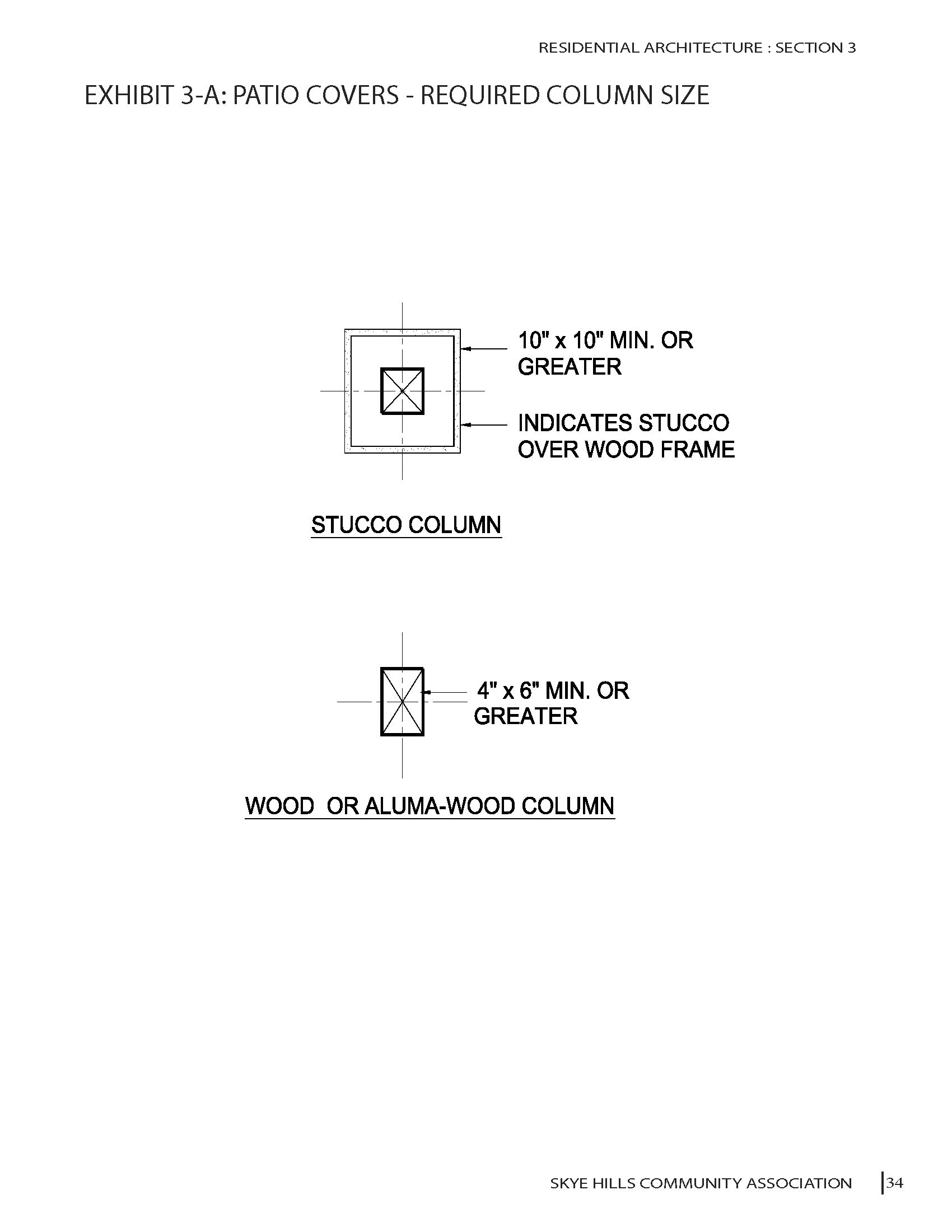
EXHIBIT 3-B: SOLAR PANEL PROTECTION
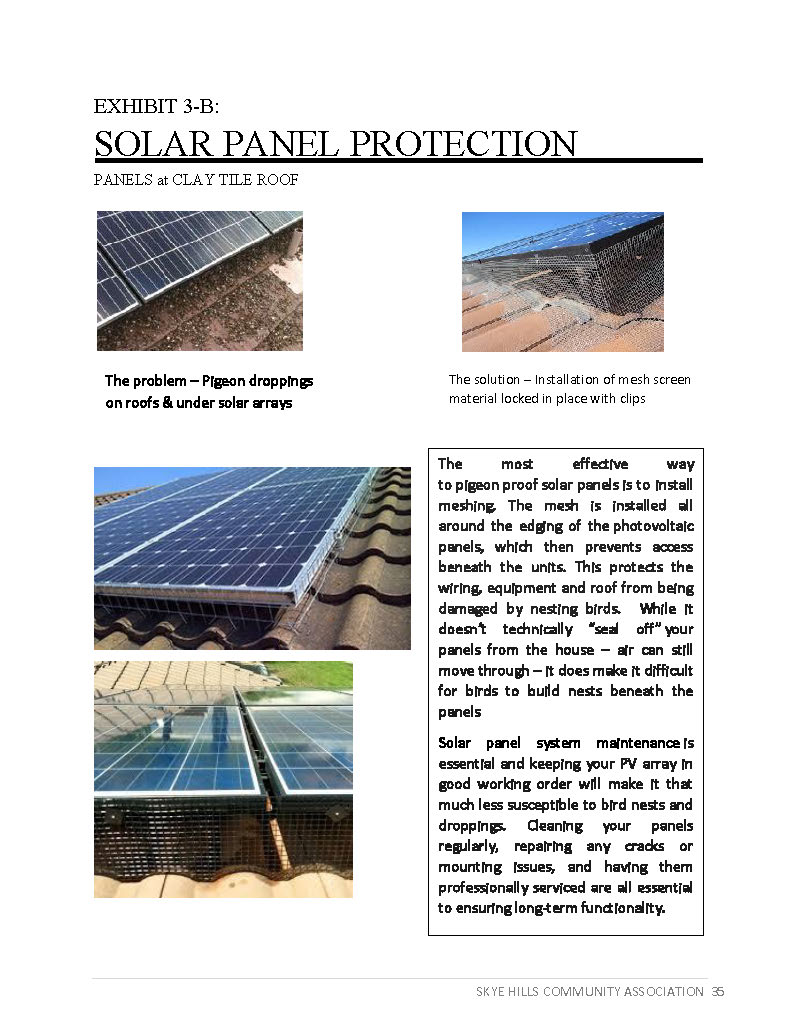
The most effective way to pigeon proof solar panels is to install meshing. The mesh is installed all around the edging of the photovoltaic panels, which then prevents access beneath the units. This protects the wiring, equipment and roof from being damaged by nesting birds. While it doesn't technically "seal off" your panels from the house – air can still move through – it does make it difficult for birds to build nests beneath the panels.
Solar panel system maintenance is essential and keeping your PV array in good working order will make it that much less susceptible to bird nests and droppings. Cleaning your panels regularly, repairing any cracks or mounting issues, and having them professionally serviced are all essential to ensuring long-term functionality.
Section 4: Residential Landscape Design Criteria
4.1 GENERAL LANDSCAPE CONCEPT
4.1.1 INTRODUCTION
This section endeavors to provide an initial framework for accomplishing the proposed landscape design strategies in addition to addressing the landscape architects' guiding principles, ideology, and philosophy, pictorialized with accompanying graphic exhibits.
Inspiration was derived from the natural, alpine settings of the surrounding environs, in particular of Mt Charleston and the Toyabe National Forest to the west of SKYE HILLS. Rustic yet contemporary in nature. Seasonal adaptability and color. Mountain lodge idyllic. Camp reminiscent. Memorable brand identity. Outdoor living destination.
In general, the planting design represents naturalized groupings or masses with a suitable multi-tiered layering of ground cover, shrubs, and a mixture of deciduous and evergreen trees. Spaces have been defined by this regular rhythmic repetition. Foliage is a mixture of contrasting and complimentary textures and colors. Seasonal flowering patterns and forms are frequent. Hierarchy, sequence, and visual order is the prevailing creative approach.
The plant palette was formulated not only to be regionally characteristic but when utilized in formal and informal patterns becomes an attraction itself. Selection for the palette includes natives, drought tolerant species, and ornamental plants which are horticulturally adaptive to the natural characteristics of the site, such as climate and soils.
4.1.2 LANDSCAPE THEME
Plant material must be tolerant of the Las Vegas climate, in particular the seasonal hot, cold and wind conditions.
XERISCAPE
The Xeriscape themed landscape is comprised of plant material commonly found in Southwestern desert environments. This environment is particularly rich in color, texture and dramatic form. The desert garden ground plane shall consist of gravel mulch, decomposed granite and/or varying size cobbles used in an aesthetic combination. Ground covers, shrubs, and trees shall be used in combination to provide interest and a "green" contrast while being drought tolerant and able to survive on reduced irrigation requirements.
TRADITIONAL
The Traditional landscape is created by using a combination of lush ground covers, shrubs and trees. The rich color and cool inviting character created by the plant materials in this zone provide a pleasant, consistent contrast to the surrounding desert environment. In addition, artificial turf areas are incorporated to reinforce the oasis character. Although not necessarily considered desert plant material, plants in this climate are able to survive climatic extremes of the Las Vegas valley.
4.2 POTS / PLANTERS / CONTAINERS / DECORATIVE ORNAMENTATION
Pots / planters / containers provide beneficial locations for color accents as well as 'structure' within the landscape. All pots shall be selected in colors and materials that complement the architecture, hardscape, and 'brand / image' of SKYE HILLS. Drip irrigation shall be provided to pot locations. Potted planting shall be used as accent only, not as the primary method of landscaping. Photos, sizes and location of proposed decorative ornamentation shall be included with the submittal. This includes, but is not limited to statuary, garden art, and other similar garden ornaments.
4.3 FINISH GRADING
No planting areas are to be graded when their moisture content is so great that excessive compaction will occur, nor when it is so dry that dust is formed and/or dirt-clods will not break up. Water shall be applied, if necessary, to provide ideal moisture content for grading.
Final grading of all planting areas shall include light rolling, raking and handwork as necessary to achieve desired contour and flow-line patterns so as to result in evenly finished surfaces. Final grading shall ensure a uniformly level surface with approved drainage, but without excessive compactions and depressions, dirt-clods, weeds and stones. Any import soil necessary to attain design grades and berms shall be free of weeds, and debris. Soil shall have a balanced pH.
4.4 SITE DRAINAGE
Landscaping should be done in a manner that ensures proper drainage so that your property, as well as your neighbors' is protected from surface waters. Maintain drainage from the rear yard through the side yard to the street, utilizing drainage pipes, rock, ground covers or grasses to prevent erosion along the side yard. Swales that have been graded around your home by the Builder, and shall not be blocked. or impeded. These shallow ditches have been put there for the purpose of quickly moving water toward the driveway, street or other positive outlet.
Do not create depressed planter boxes or areas next to foundations such that irrigation or rain water collects in them. See Exhibit 4-G.
Surface drainage of hardscape/ paved areas must have a minimum slope of 1% away from buildings, walls, or structures and shall be directed to surface drains or drainage ways. Pooling of drainage water on hardscape areas will not be permitted. See Exhibit 2-C. Surface drainage of softscape areas, such as turf and/or shrub beds, shall have a minimum slope of 2% away from buildings and structures. It will be permitted to swale surface run-off in large turf areas at a minimum 2% slope to the nearest inlet or top of curb location.
All sites unable to meet these minimum surface drainage rates must use underground drains. Drainage over the rear top of slope or onto adjacent property is prohibited.
All drains must have underground drain-line pipes that maintain a minimum drainage rate of ½% slope. All drain lines material must be rigid Polystyrene, 1000 lb. crush strength or equal, except when cast iron is required. Flex or ribbed drain line material is acceptable in some cases where a drain-line radius must be achieved. Solvent is to be used for all fitting installations per the manufacturer's recommendations. All drains must contain inlets with an appropriate grate.
4.5 LANDSCAPE ZONES
Each lot has defined landscape zones as noted below. Plantings in these zones should be designed to create a cohesive environment throughout SKYE HILLS. The landscape packages provided by the builders in the purchase of the residences have been pre-approved. The minimum tree and shrub quantity installed by the original home builder must be maintained, but may be enhanced. Landscaping is considered an integral part of the overall lot. As a design element, consideration must be given to the relationship to adjacent houses and surrounding area. All landscaping, plantings and installation of permanent irrigation systems by an owner shall remain aesthetically consistent with the architecture and plan of the community. The three landscape zones are:
- Front Yard Landscape Zone Installed by the Builder
- Side Yard Landscape Zone Installed by the Homeowner
- Rear Yard Landscape Zone Installed by the Homeowner
4.5.1 FRONT YARD LANDSCAPE ZONE
The front yard landscape zone is that portion of the front yard measured from the back edge of the streetscape zone to the front wall plane of the house. The homeowner is encouraged to enhance front yard landscape zones with additional plantings. Refer to Table A for the minimum Front Yard Landscape Requirements.
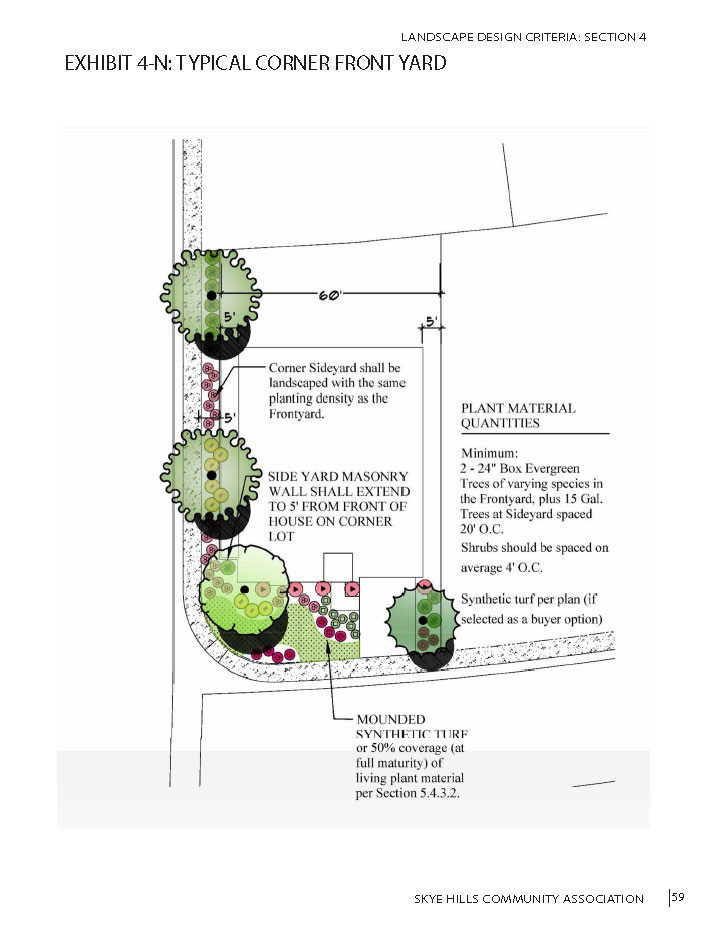
Corner lots shall be landscaped as an extension of the front yard zone. Consistent plant species and densities shall be continued /wrapped around the 'corner'; including, but not limited to, extension of artificial / synthetic turf, planting areas, and applicable hardscape. Any exposed walls must be screened by plant material to break up expanses of the wall.
Informal plantings are appropriate in front yards. However, massing of planting is encouraged to create more structure within the yard. Landscape designs should incorporate grouping of similar plant materials and layering of shrubs and accents based on heights, color, and texture to create sweeping forms and plant hierarchy. Species should be selected to provide accents within densities that are consistent with the public realm landscape designs.
Trees shall be located so they compliment the individual home design and driveway location. Like-tree massing is encouraged in the landscape design. Trees should be used in groups rather than individually unless the tree is being used as an accent element.
Shrubs and ground cover should be used in groupings of similar plants positioned to complement other plants of varying heights and textures. Shrubs and ground cover used in hardscape areas must have adequate planting to create at least 50% of living plant cover per planting area at full maturity.
Avoid planting shrubbery too close to foundations. Such planting shall be located a minimum of 30 inches (2'-6") from the foundation (includes property line walls).
4.5.1a SIDE YARD LANDSCAPE ZONE
The side yard landscape zone is that portion of the yard measured from each side wall plane of the house in front of the return walls. Shrubs and ground cover should be used in groupings of similar plants positioned to complement other plants of varying heights and textures. Refer to Table A for the minimum Side Yard Landscape Requirements.
TABLE A:
Front Yard Landscape Requirements:
| Requirement | Specification |
|---|---|
| Minimum Tree Quantity | 2* |
| Minimum Shrub Size | 5 gallon |
| Minimum Ground Cover Size | 1 gallon |
| Ground Cover Materials (Planting Coverage) | Artificial Turf or Plants (no artificial plants) |
| Minimum Planting Coverage (Trees are not part of the minimum coverage) | 50% ** |
*Corner lots shall have one 15 gallon tree for every 20 linear feet planted along the side yard facing the street.
** Percentages shown are at two-year's growth. All shrub and ground cover are shall be covered with a decorative gravel mulch in accordance with these Design Guidelines.
4.5.2 FRONT YARD RESTRICTIONS
SNWA no longer allows new turf in front yards. Homeowners are responsible to comply with SNWA. The minimum width of an artificial lawn area shall be 6 feet. Artificial turf shall be kept at least 30 inches (2'-6") from a building face or wall. Any wall or structure within the Front Yard Landscape Zone shall not abut a sidewalk or back-of-curb without a five foot (5') minimum landscape buffer.
4.5.3 FRONT YARD CONVERSIONS
Artificial turf removal MAY be considered. When removed, the planted areas shall contain enough living plant material to cover at least fifty percent (50%) of the area at full maturity. Front yards shall require a minimum of two (2) 24" box size EVERGREEN trees. Corner lots require additional trees as stated in section 4.5.1a. Shallow rooted trees shall not be used in front yards. When artificial turf is installed in a yard, refer to section 4.6.4 for requirements.
4.5.4 TRANSITION AREAS BETWEEN LOTS
Treatment of the area where the landscape of two lots abut should be similar to create a unified and more expansive landscape feeling. Treatments may include turf, gravel mulch, and shrub and ground cover planting. A hard edge treatment (i.e. mow strips, edging walls, etc.) between lots will not be acceptable.
4.5.5 FRONT YARD HARDSCAPE & STEPS
The minimum width of an entry walk is 4-0". Entry walks shall be separated from a building wall by a minimum three foot (3'-0") wide planting strip (where structures allow) that shall be fully planted. A walkway next to a driveway without a minimum 24 inch wide (24") planter separating the driveway from the walkway is considered a driveway extension. Provide the location, size, material of proposed steps. The submittal must include the height of each step (rise) and the width of the tread (run).
4.5.6 REAR YARD RESTRICTIONS
Some lots adjacent to community open space feature tubular steel fencing installed by the builder along the rear property line and returning approximately 15 feet along each side property line. A field of vision exists for these lots and is determined by establishing a point 15 feet from the property corner along the rear property line and another point measure 15 feet from the property corner along the side property line. The imaginary line connecting these two points forms the field of vision. Landscape improvements within the field of vision are limited to turf, ground cover, or other low elements less than 30 inches (2'-6") high. Refer to Exhibit 4-J.
4.6 PLANTING REQUIREMENTS AND PLANT PALETTE
The plants listed in the plant palette are approvable for use in all parcels at SKYE HILLS. Review EXHIBIT 4-A for the Recommended Plant List.
4.6.1 MULCH
All planter areas shall be covered with a top dressing of decorative gravel mulch. Bare ground is not permitted. The use of different sizes of one gravel mulch color is encouraged. Required minimum specifications are:
- Top dressing shall be a minimum of 2 inches in depth.
- Mulches shall range from 3/8 inch, (min) diameter to 3/4 inch (min) diameter. Larger sized mulch can be used only for accent areas within the yard and on steep slopes for stabilization.
- Chat (or mulch material smaller than 3/8 inch) shall be used for accent areas only.
A maximum of two gravel mulch colors may be used. The two colors must be closely related and create a harmonious ground plane when used adjacent to each other. Mulch color should be strong in character so as to create a finished appearance. Recommended colors to be in tones of red or gold.
Prohibited:
- White rock
4.6.2 BOULDERS AND COBBLE
Boulders and cobble can provide interesting accents in the landscape. If used, they shall be in natural patterns and / or clusters to accent grade changes or land patterns. Boulders shall be set one-third (1/3) of their height in the ground to appear as 'natural' as possible. Use of manufactured or faux boulders shall not be permitted in front yards. Larger granite cobbles ranging 6 to 12 inches in size and/or boulders may be used for accents such as dry streams and focal points. Large cobble shall not exceed 15% coverage. Plantings and boulder outcrops shall be integrated into the cobbles for effect. The color of these larger rocks should be the same as or complementary to the gravel mulch used. Refer to Exhibit 4-I. River rock beds are encouraged. Alternative material such as natural granite cobble may be acceptable.
4.6.3 TURF
Grass and Spray Irrigation - The Southern Nevada Water Authority (SNWA) has adopted a rule which specifies that newly constructed homes sold with a closing date after April 1, 2022, are prohibited from having grass and spray irrigation systems installed anywhere on the property. Compliance with SNWA is required. Refer to the Southern Nevada Water Authority website (www.snwa.com) for more information.
4.6.4 SYNTHETIC TURF (Artificial Turf)
All synthetic turf shall have a header separating the turf from the adjacent ground cover material. Artificial turf must be installed in a manner consistent with natural turf installation. Combinations of grass and artificial turf will not be permitted, nor will any combinations of different types of artificial turf be permitted. Each application for installation must be supported by the specifications of the product and the method of installation.
Specifications: the material/product must meet or exceed the following:
- Fiber Type: Polyethylene. (May include no more than 40% nylon)
- Yarn Denier: 10,000 – 11,500 denier/ Texturized monofilament polyethylene
- Face Weight: Minimum 60 oz. per sq. yard
- Pile Height: Minimum 1¾" – 2" maximum
- Color: Natural turf
- Tufting Gage: 3/8" – 1/2" maximum
- Stitch Rate: Minimum 14.5 on 3"
- Backing: URETHANE, min. 20 oz. per sq. yd. – adequate drainage required
- Product Total Weight: 80 oz. per sq. yard
- Infill Type: No rubber infill. No uncoated silica sand
- Product cannot contain measurable quantities of lead in any capacity or manner.
- Product must be first quality goods and must be warranted for a minimum of 8 years for defects in material resulting in premature wear due to ultraviolet radiation from the sun.
Installation:
- Turf must be placed over sand and other fine aggregate that measures two inches (2") in depth and it must be mechanically compacted. No concrete or reject sand will be permitted under the turf.
- Trees and shrubs installed adjacent to or inside the artificial turf areas will be challenged for sufficient irrigation water; therefore, deep root or subsurface irrigation techniques should be incorporated into irrigation plans. Trees and shrubs installed inside the artificial turf areas must have tree rings that are a minimum of twelve inches (12") beyond the mature caliper of the tree. The rings must be covered with approved mulch.
4.6.5 TREES
Trees shall be spaced at least fifteen feet (15') apart. If trees need to be spaced more closely, they should be of the same tree species. Front yards shall require a minimum of two (2) 24" box size EVERGREEN trees. Shallow rooted trees shall not be used in front yards. Corner lots, or larger front yards shall require additional trees. Corner lots shall have a 15 gallon tree for every 20 linear feet planted along the side yard facing the street.
Trees shall not be planted closer than three feet (3') from any wall, structure, sidewalks, curbs, driveways, fences, or utility line. Shallow rooted trees shall not be used in front yards. This is applicable to palm species also. Refer to Exhibits 4-C through 4-F.
4.6.6 ROOT BARRIERS
All trees, unless otherwise specifically noted in this Homeowner Design Manual, planted within 6 feet of any hardscape or structure shall be installed with a 24 inches deep by 10 foot minimum linear root barrier. Linear root barriers shall be installed continuous along the edge of a wall, structure, or hardscape – extending a minimum of five feet (5') past the gallon / box edge on each side of the tree. The root barrier will minimize any lifting and/ or cracking of hardscape areas and structures. Refer to Exhibits 4-C through 4-F.
4.6.7 PLANTS and SHRUBS
The planting guidelines are intended to maintain a minimum standard installation of planting suitable to the SKYE HILLS Community. Planted areas shall contain enough living plant material to cover at least fifty percent (50%) of the planting area at full maturity. Planted areas shall have a minimum of 60% evergreen plant selections. 5 gallon shrubs and plants shall be used for all front yard planting. Accent plants and annuals may be 1 gallons.
Plants and shrubs shall be a minimum of 30 inches (2'-6") from any wall or structure. Exceptions are made based on the review of particular species of plants. Refer to Exhibit 4-G.
To ensure similar coverage of plant materials and a smooth transition between streetscape design and lots, planting densities shall be based on planting area square footage (excluding any artificial / synthetic turf). In order to achieve this effect, the palette of plant species is limited to no less than five (5) no more than ten (10).
4.7 SITE PREPARATION GUIDELINES
All property lines and utility locations must be verified prior to commencement of any work.
All permits, fees and agency inspections, as required must be obtained prior to commencement and/ or completion of any work.
All demolition, clearing, grubbing, striping of soil, excavation, and compaction and grading must be performed within the confines of the homeowner's yard.
Landscaping installed by the master developer, builder, or subsequent association, if any, must be protected at all times through the use of fencing or other protective barriers. Any damage to the existing landscaping or irrigation systems must be repaired at the expense of the homeowner.
Homeowners should make themselves aware of any potential problems, such as penetrating caliche soil, when preparing a site. It should be noted that all contractors should include an allowance in their bids for penetrating through caliche when it is encountered in tree planting pits or any other landscape element.
Exhibits - Section 4
EXHIBIT 4-A: RECOMMENDED PLANT LIST
(Other species not listed may be considered.)
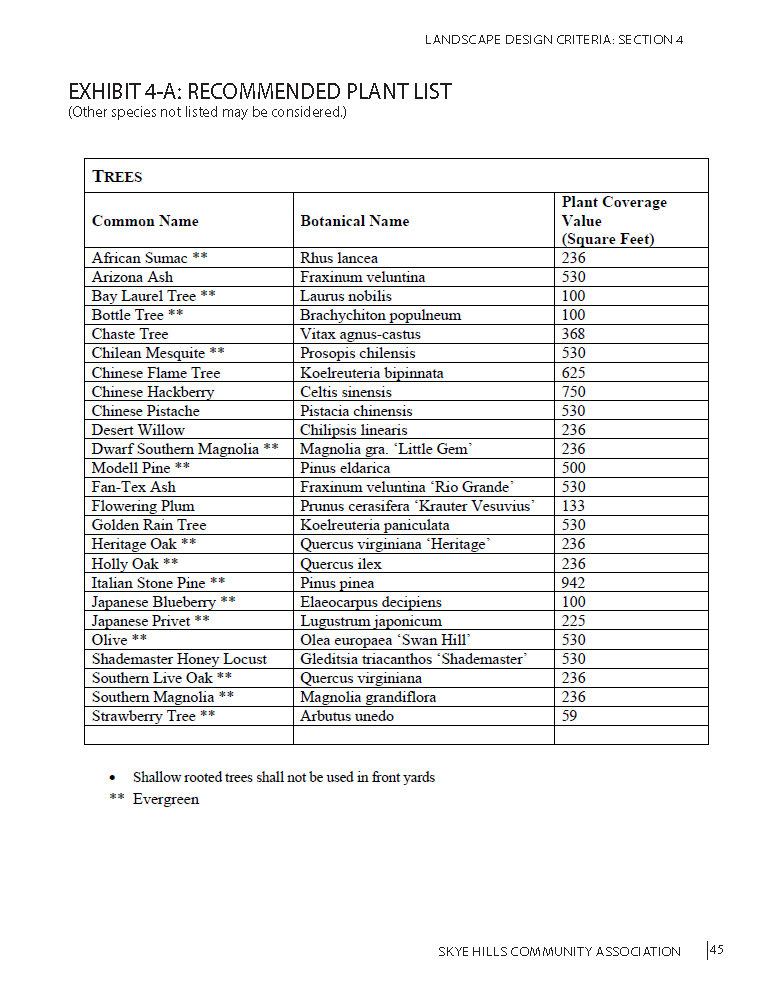
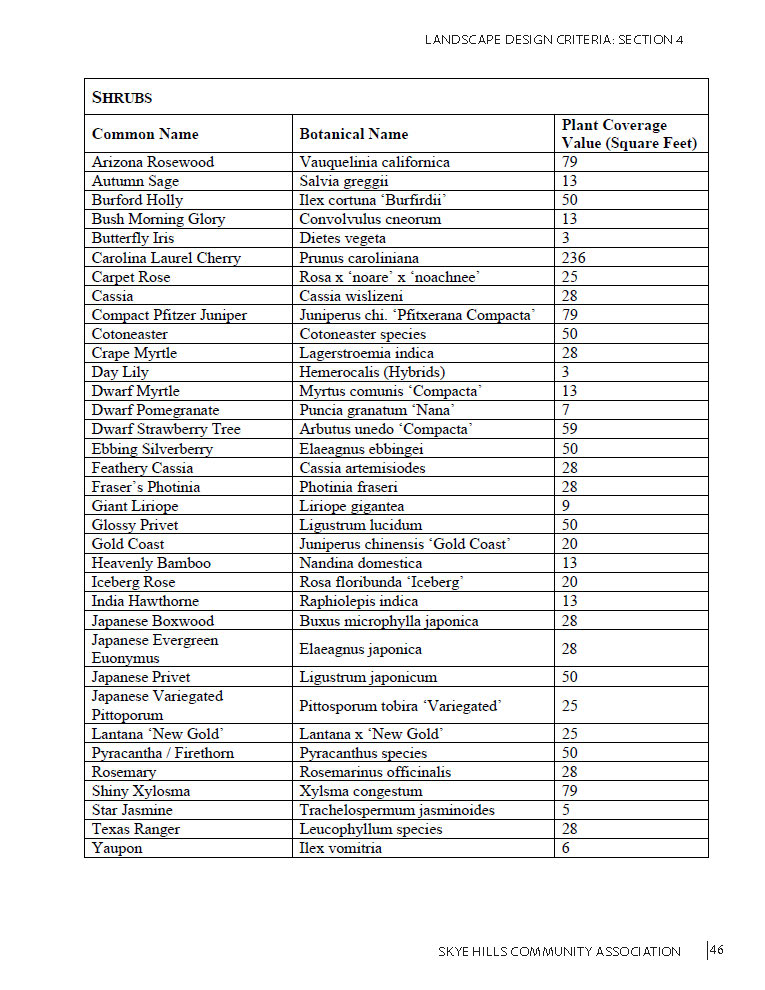
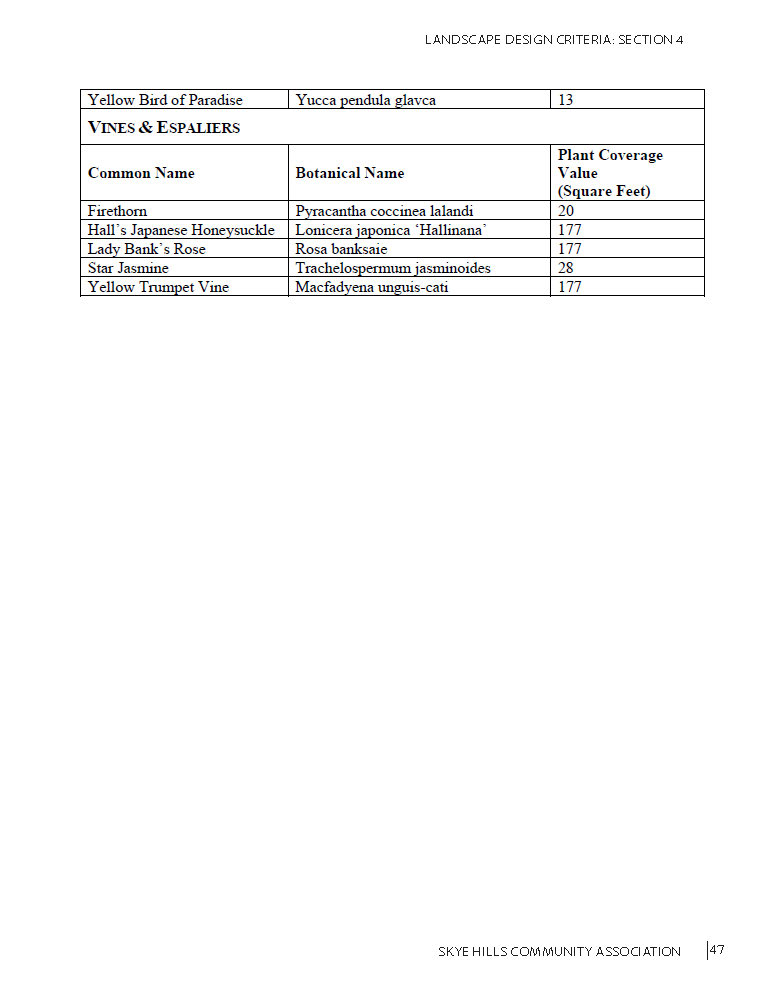
EXHIBIT 4-B: PROHIBITED PLANT LIST
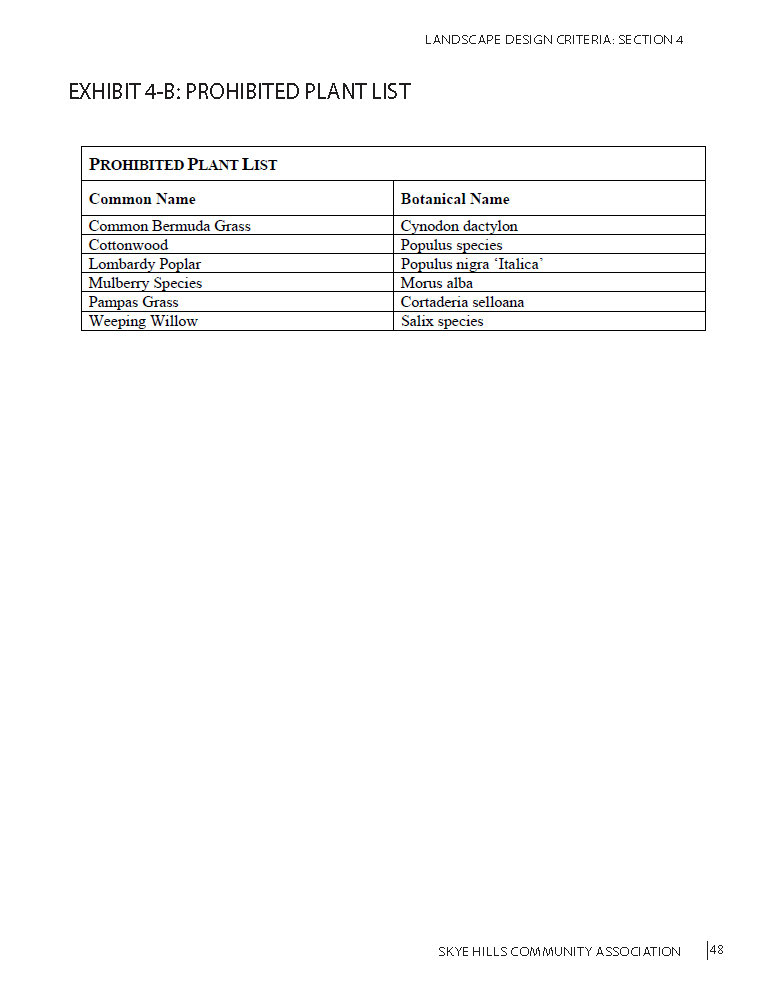
EXHIBIT 4-C: ROOT BARRIERS REQUIRED
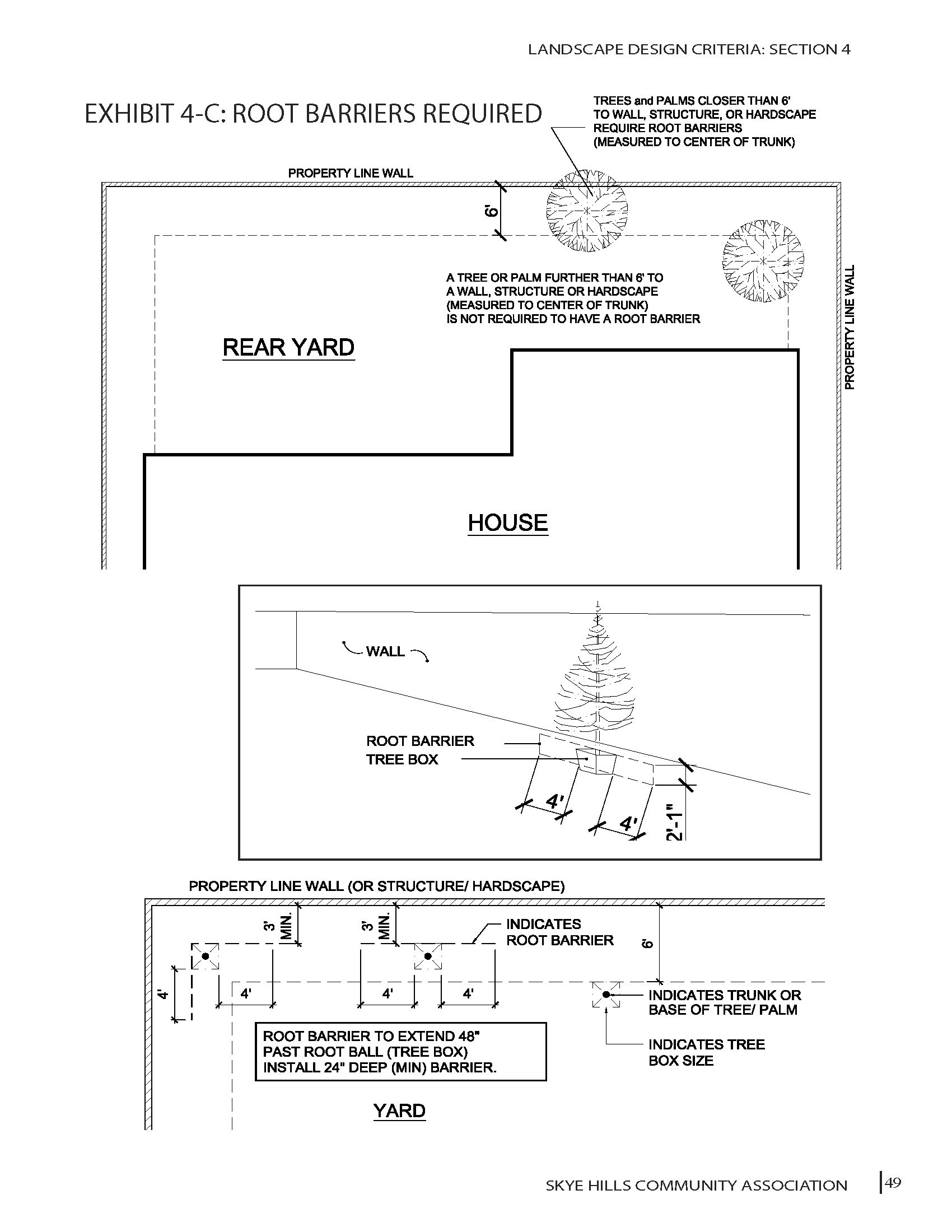
EXHIBIT 4-D: ROOT BARRIERS AT WALLS
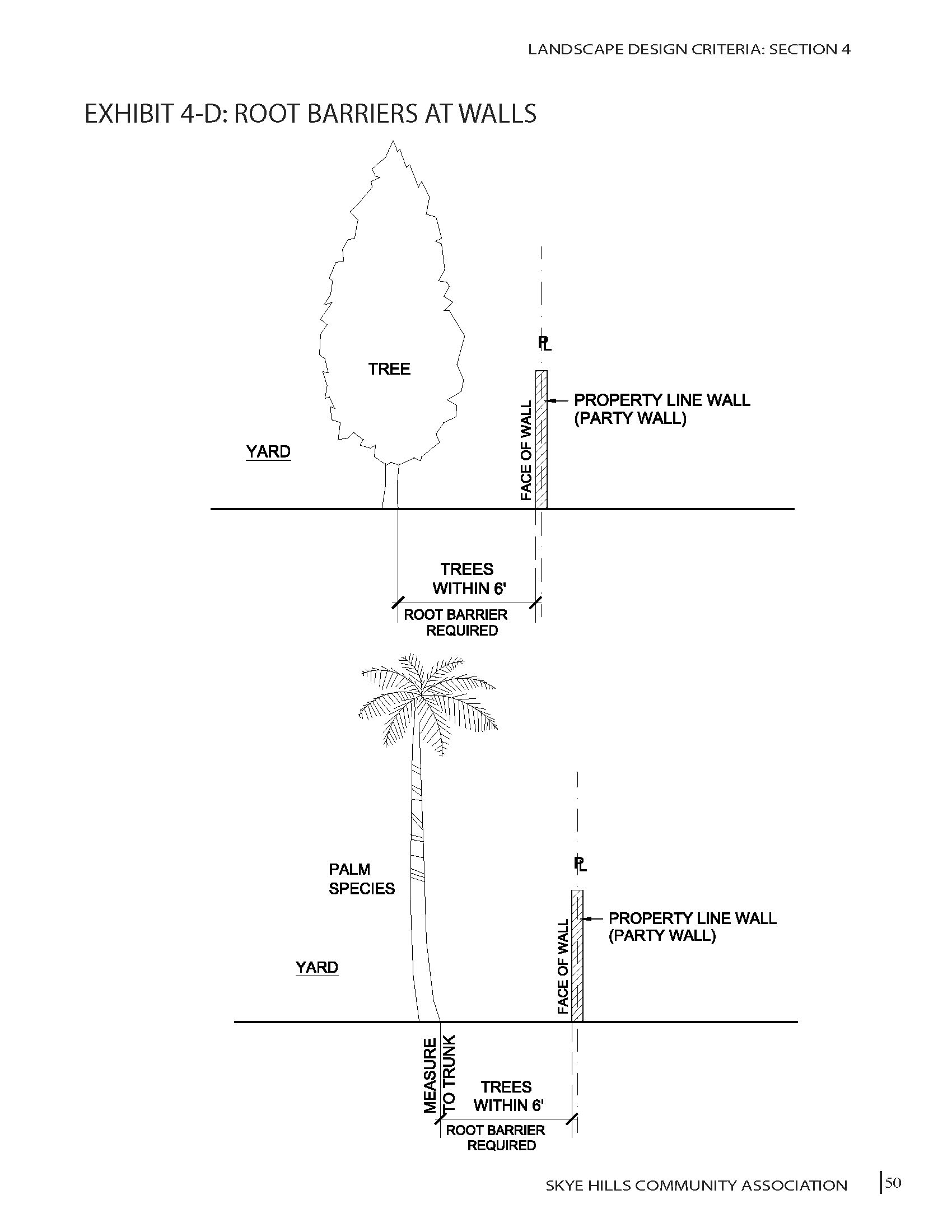
EXHIBIT 4-E: ROOT BARRIERS AT HARDSCAPE
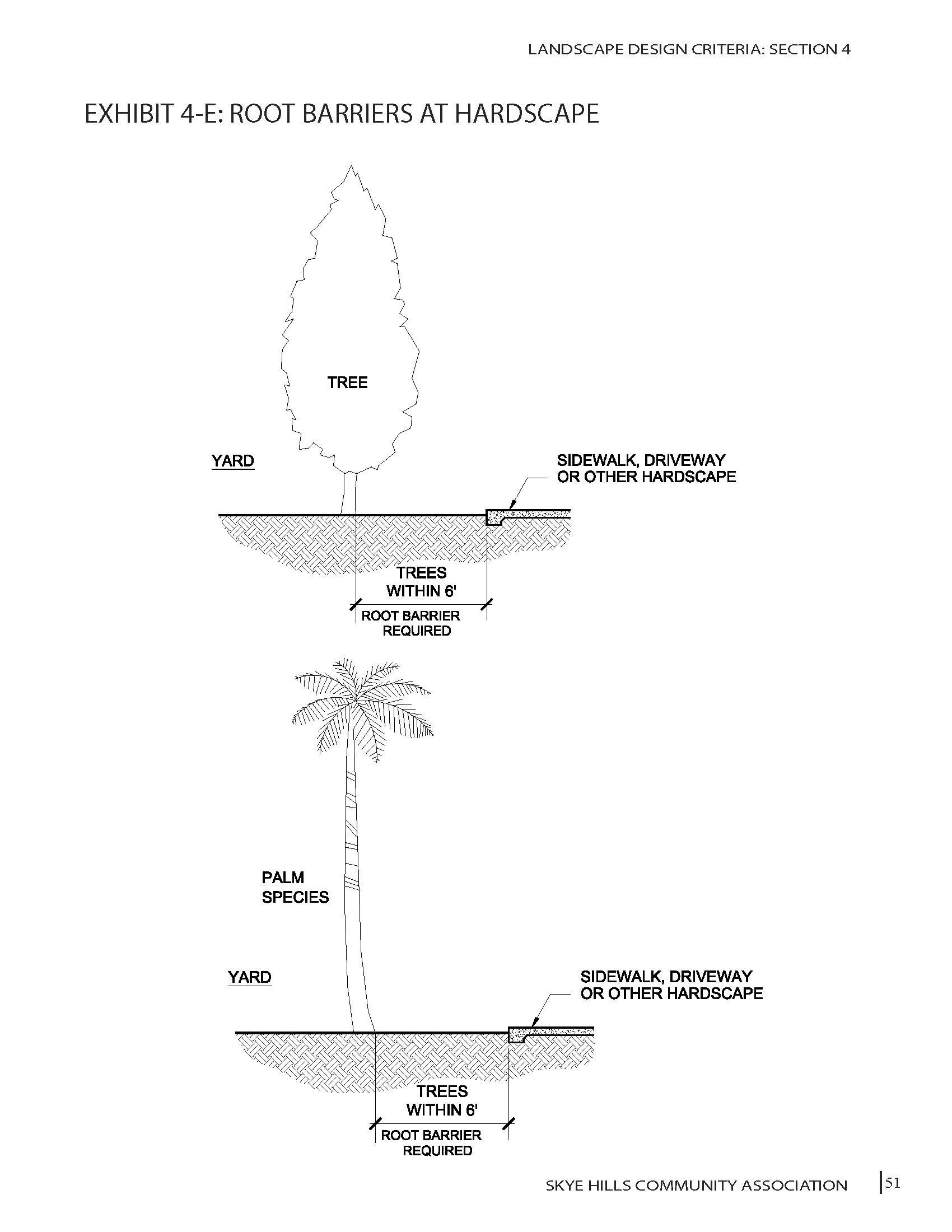
EXHIBIT 4-F: MINIMUM PLANTING DISTANCES
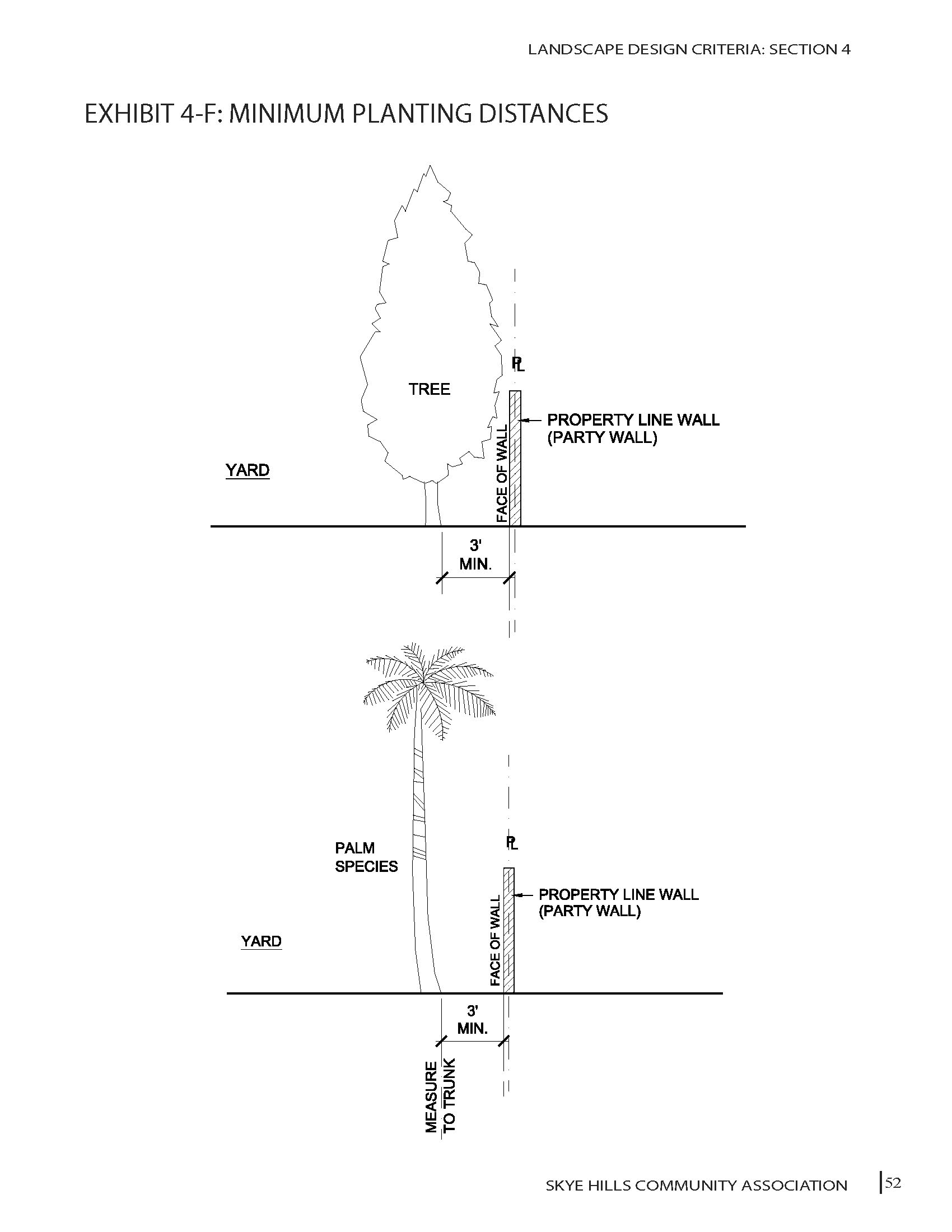
EXHIBIT 4-G: MINIMUM PLANTING DISTANCES
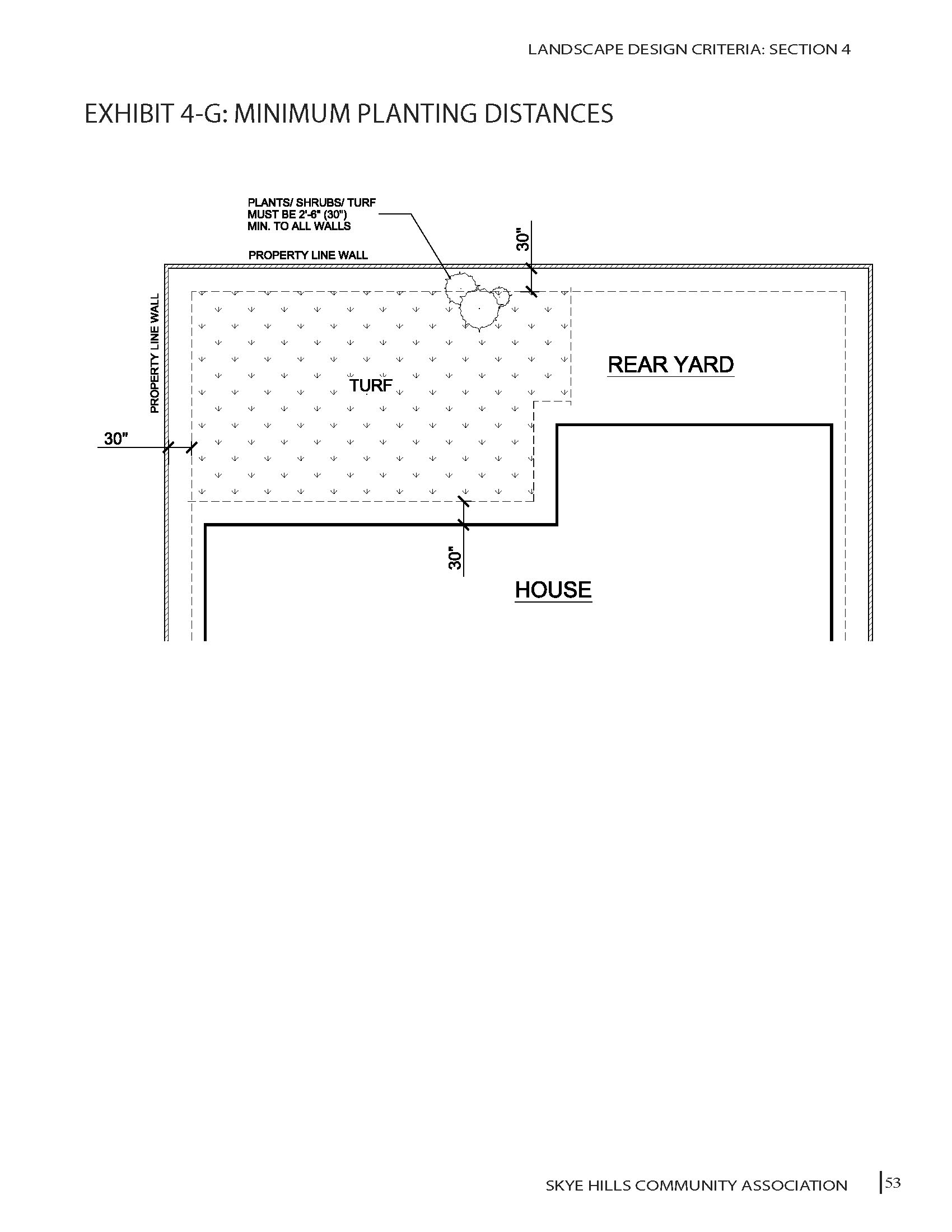
EXHIBIT 4-H: PLANTERS
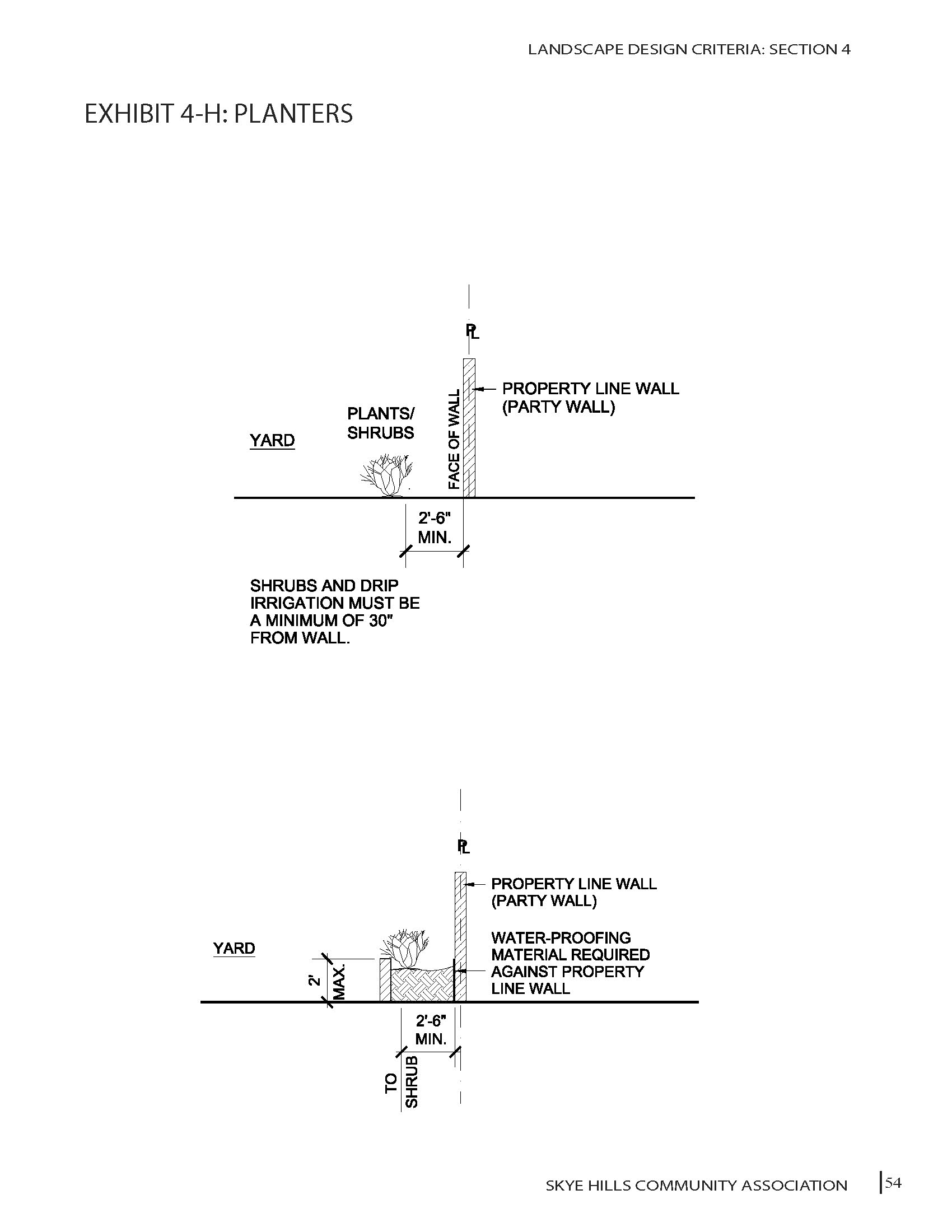
EXHIBIT 4-I: BOULDERS
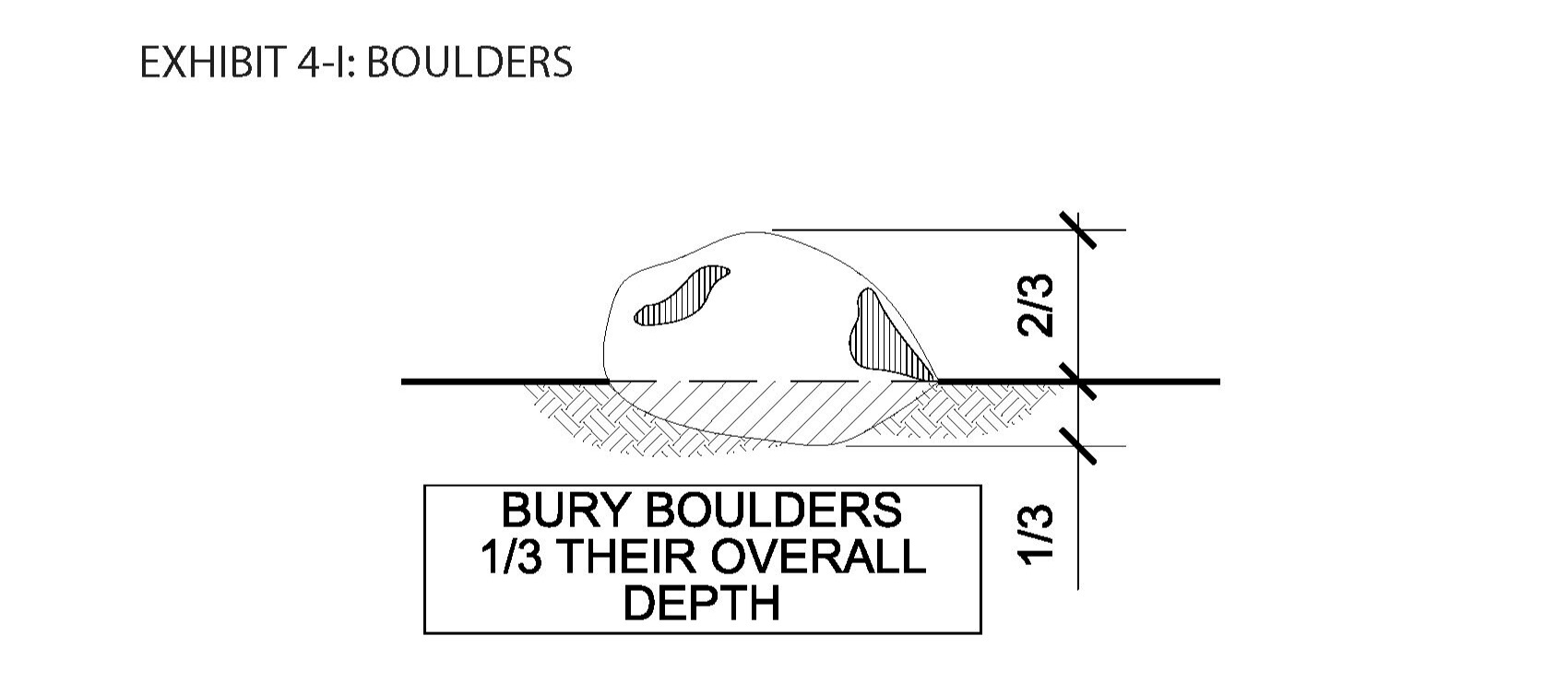
EXHIBIT 4-J: REAR YARD CONE OF VISION
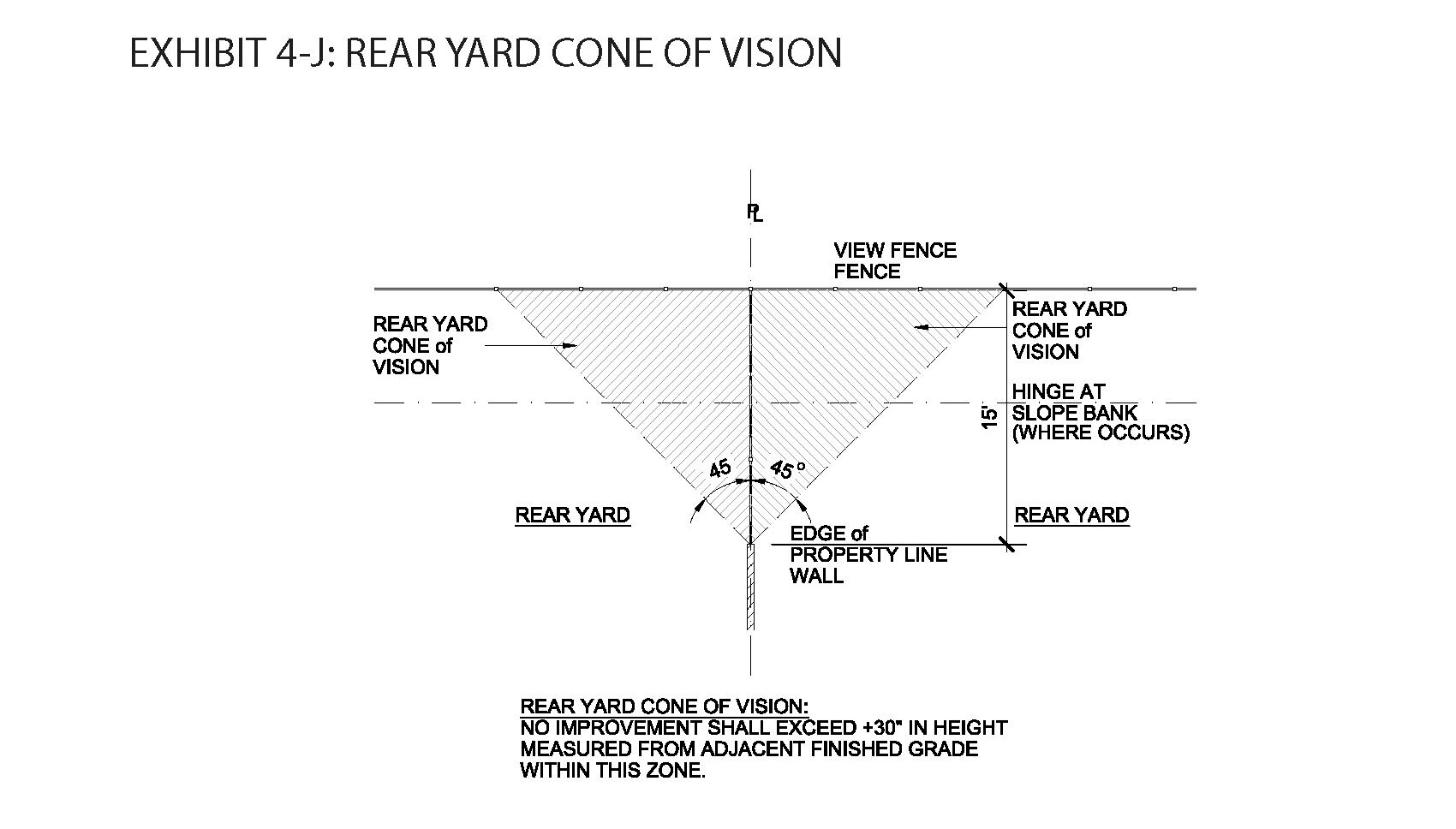
EXHIBIT 4-K: TYPICAL FRONT YARD
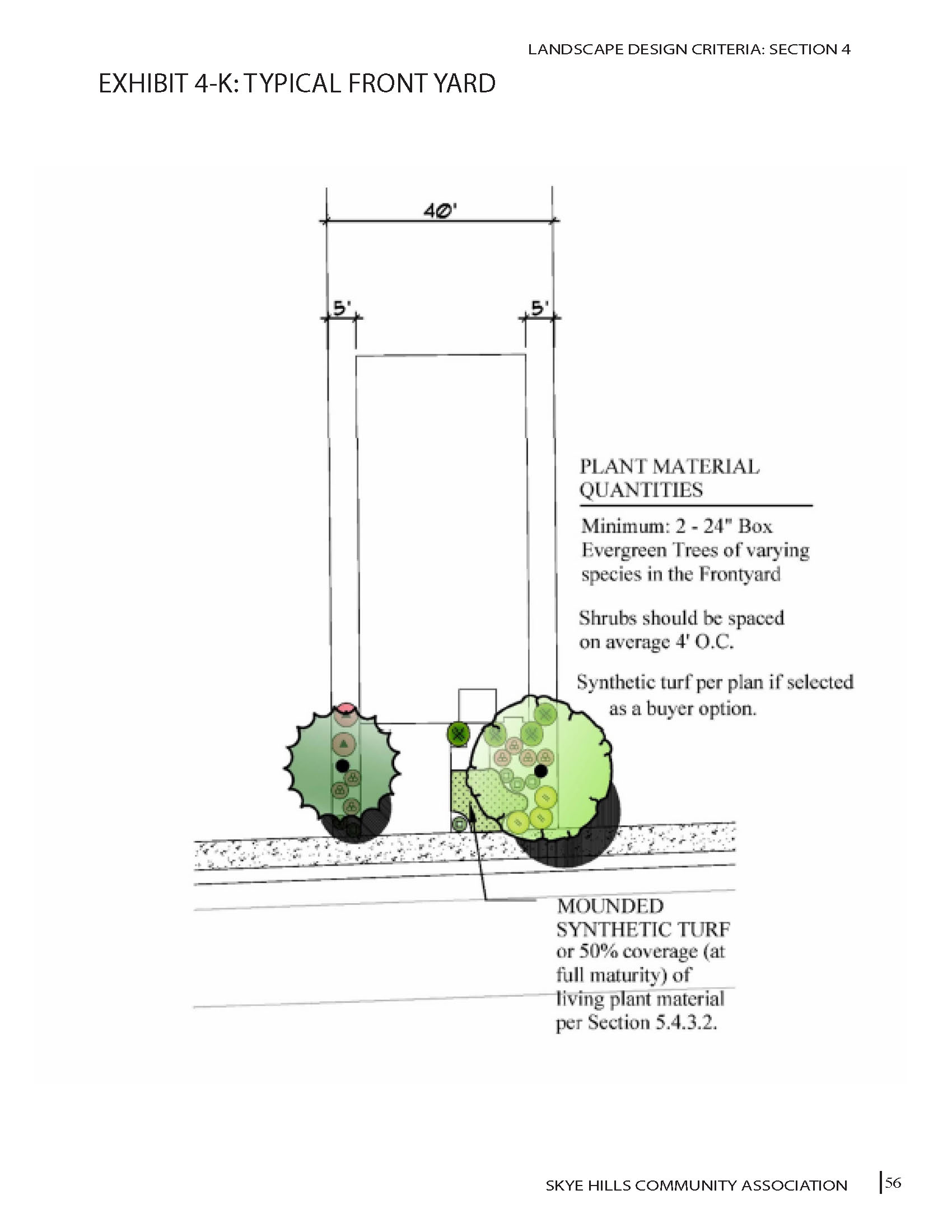
EXHIBIT 4-L: TYPICAL FRONT YARD
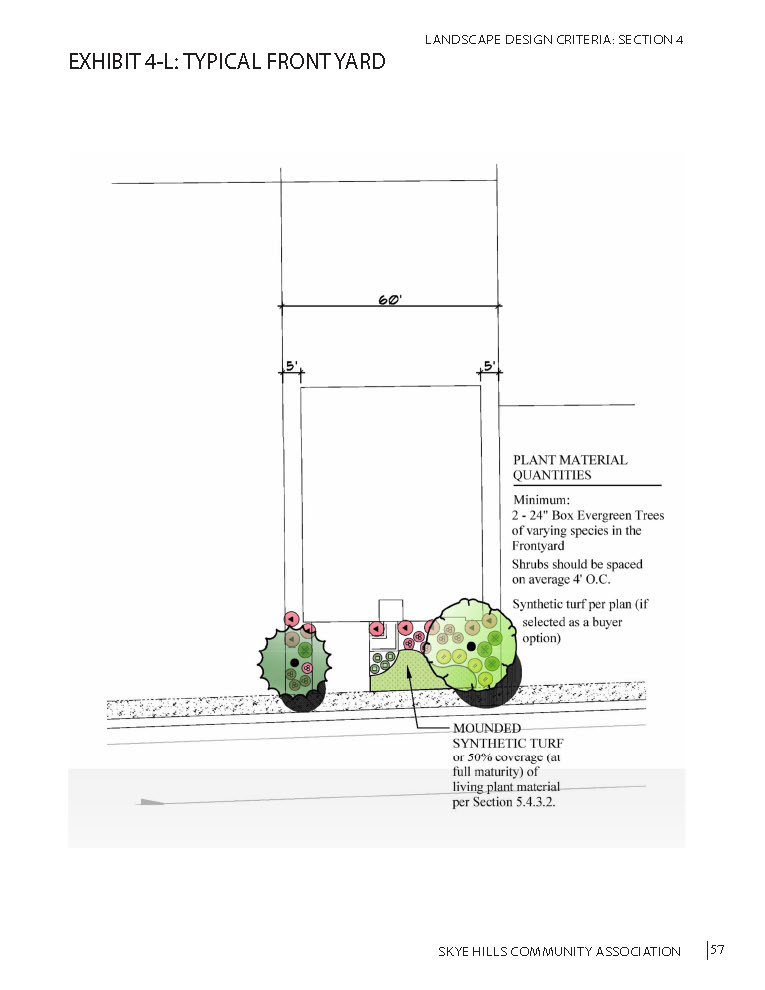
EXHIBIT 4-M: TYPICAL CORNER FRONT YARD
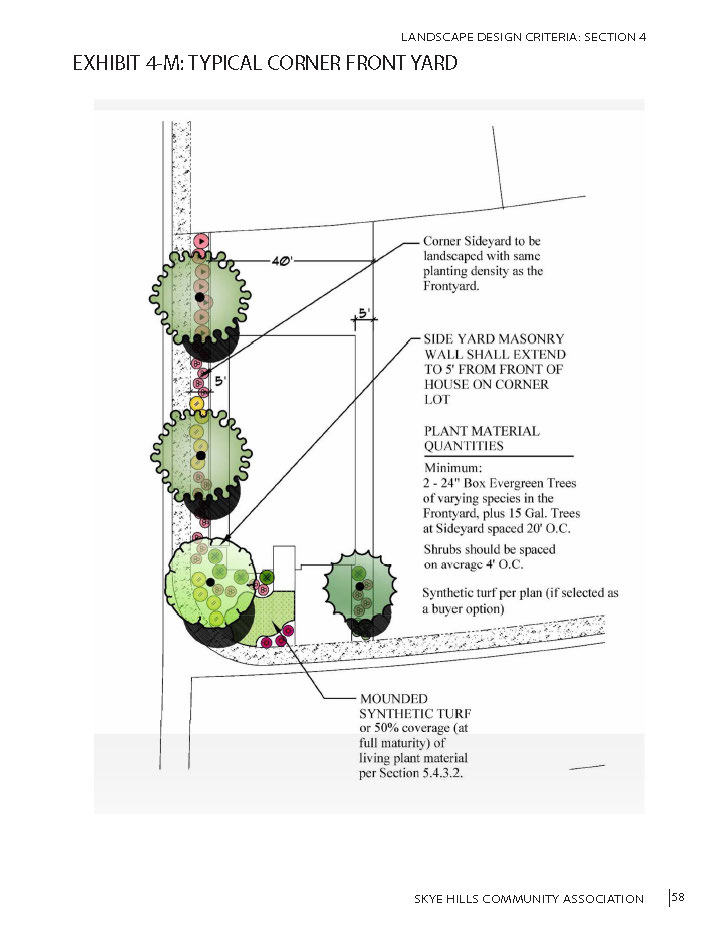
EXHIBIT 4-N: TYPICAL CORNER FRONT YARD
Section 5: Design Review Process
5.1 INTRODUCTION
The SKYE HILLS Board of Directors shall administer all submittals for design review, with regard to the implementation of the Design Guidelines. The procedure described below shall be used to administer the implementation process. Complete submissions are required in order to make for an expeditious review.
As an expression of the developer's vision for SKYE HILLS, the Design Guidelines are intended to provide homeowners, builders, architects, civil engineers, and others an overall direction in the design process. The requirements of the design criteria provides examples of ways in which the vision can be achieved; however, creativity, innovation and variety are encouraged throughout SKYE HILLS. Therefore, design proposals may reflect a certain level of flexibility, as long as the overall intent of the community vision and design criteria is achieved.
5.2 IMPROVEMENTS REQUIRING REVIEW
All proposed improvements to structures or site elements by the applicant will require review and approval. Improvements requiring review include but are not limited to utility and drainage systems, sidewalks, residential structures including new construction, remodels and additions, accessory structures paving and landscaping.
Any improvement that requires a building permit from the City of Las Vegas will require SKYE HILLS review and approval prior to obtaining the City permit. A copy of the SKYE HILLS approval letter shall accompany the submittals to the City.
Any owner having an existing improvement that was not built by the original home Builder and does not have a written approval letter from the Association requires review. The Owner must file an Architectural Review Application requesting written approval for the existing conditions. This may include, but is not limited to swimming pools, patio covers, landscaping or other built structures. The Association may require copies of building permits for those improvements that require City approval. A pre-existing improvement constructed by current or prior owners without prior written approval does not guarantee approval of the existing condition. A pre-existing improvement that does not comply with these Design Guidelines may need to be modified or removed, based on the findings of the review.
5.3 PLAN CHECK FEES
The Board of Directors shall have the right to require payment of reasonable fees for the review of proposed plans and other materials and site observation of constructed improvements.
5.4 IMPACTED NEIGHBOR STATEMENT
All proposed improvements to structures or site elements require the submittal of an Impacted Neighbor Statement form. This form requires the signature of all abutting property owners, and is designed to provide notice to the neighbors regarding any improvements that may have an affect on the use, enjoyment, or value of their property, as well as to promote communication and avert potential problems.
5.5 REVIEWER
The Reviewer shall review each project submittal. In addition, the Reviewer may consult with other professional advisors as deemed appropriate. The Reviewer may be contacted through the community management company. The Reviewer, at its sole discretion, may "approve" or "deny" any project submittal. The Reviewer may be contacted at the following address:
SKYE HILLS Community Association
11411 Southern Highlands Parkway, Suite 100
Las Vegas, NV 89141
5.6 DESIGN REVIEW AND APPROVAL PROCESS
The purpose of the design review process is to ensure that proposed improvements meet the requirements of the Design Guidelines and Declaration. The Reviewer assumes no responsibility for plan review of local codes or ordinances. The Reviewer will evaluate the submittal in accordance with the criteria described in this Homeowner Design Guidelines.
APPROVED:
Submittals that are "Approved" may then be submitted to City of Las Vegas for their review and approval if required. All plans must be approved by the Reviewer prior to submission to the City of Las Vegas. Homeowners with submittals "Approved" by the Reviewer and City of Las Vegas (if required) may commence with site improvements in accordance with the approved plans. Any change to the approved plans must be re-submitted for review and approval.
DENIED:
Submittals that are "Denied" generally fail to meet the intent of the Design Guidelines. A denial response may be requesting additional information for the Reviewer to clearly understand the intent of the proposed improvement. Based upon the review comments, the submittal should be thoroughly revised to more fully adhere to the goals and objectives of the criteria. A written response is always required by the homeowner in response to a Denial letter.
5.6.1 SUBMISSION REQUIREMENTS
AN INCOMPLETE SUBMITTAL PACKAGE WILL DELAY THE REVIEW PROCESS.
The following list is provided to assist a property owner in preparing the submittal package.
ONE ORIGINAL COPY OF THE SUBMITTAL PACKAGE IS REQUIRED. Submittal quantities are subject to change. Verify current requirements with the Association prior to submittal.
- Architectural Review Request Form: This form must be completed in its entirety.
- Impacted Neighbor Statement: This form must be signed by the affected neighbors which will typically be "adjacent" and "rear". However, "facing" neighbors must sign the form if the proposed Improvements will be visible from the street.
- Plans (must be legible and to scale): Plans include elevation drawings of the improvement, size and types of materials to be used, a site plan depicting the improvement on the lot and in conjunction with property lines, the residence, and any other existing pertinent Improvements. Accurate dimensions (height, length, width) must be shown. Exterior colors and finishes must be called out.
- Landscape Plans (plans must be legible and to scale): Landscape plans must be drawn to depict the lot, residence, property lines, existing walls, and fences. Landscape materials, such as sod, turf, tree and shrub types and sizes must be called out, as well as their location. Irrigation and lighting must be shown.
- Photographs: (Color): Photos must be submitted as part of the application for review to convert existing yards, color changes to the home, addition of exterior light fixtures or security cameras. The Reviewer may request photographs for clarity during a review.
- Material Samples: Color paint chips, type of rock to be used, sample of synthetic turf (min size 12 inches square) pictures of gazebos, pools, patio covers, and spa shall accompany the detailed drawings where applicable.
5.6.2 APPLICATION RESPONSE TIME
After a submission is accepted as complete and in accordance with all the submittal requirements, the Reviewer shall approve, or deny the application within 30 days. Submittals must be complete. If a response is not sent within 30 days, the application shall be deemed denied.
The Reviewer's evaluation will consider layout, design and placement of buildings, structures, amenities, driveway and parking areas, and other site features for their conformance with these Design Guidelines as well as for their ability to create an appropriate residential scale and a pleasant living environment. The design review shall include, but is not limited to, architectural style, building size, building massing, building location, materials, colors, relationship to existing site features, grading and drainage, parking, landscape, special site features, and impacts to surrounding lots. Specific requirements and recommendations to achieve these elements are detailed throughout the design criteria.
5.6.3 APPLICABLE STANDARDS
The Reviewer shall review each submission for the design's commitment to overall community development and adherence to the design criteria and any other applicable standards. The Reviewer is not responsible for the review of submissions to determine conformance to any applicable codes and standards established by public agencies.
5.6.4 COMMENCEMENT
Construction may not begin on any improvements until all submittals for that improvement have been approved. Any change to the approved plans must be resubmitted for review and approval.
5.6.5 CITY OF LAS VEGAS SUBMITTALS
Drawings to be submitted to City of Las Vegas must be approved by the Reviewer prior to submission to the City. A copy of the permit may be requested thereafter.
5.7 APPLICATION FORMS
An Architectural Review Application Form must be submitted with any design submittal. This form may be obtained from the Association office. If a party other than the property owner will be submitting on the Owner's behalf, the Owner must submit authorization in writing to the Association naming that party as an authorized agent for the purposes of the review.
5.8 ADMINISTRATION
5.8.1 FEES
The Board of Directors shall have the right to require payment of reasonable fees for the review of proposed plans and other materials, and site observation of constructed improvements.
5.8.2 AMENDMENT
The design criteria are subject to interpretation by the Reviewer. The developer or Board may amend or augment the Design Guidelines to meet specific site or functional requirements of property within the community, consistent with the basic objectives of the developer.
5.8.3 PREVALENCE OF DECLARATION
In the event of any conflict between the provisions of the Design Guidelines and the Master Declaration of Covenants, Conditions and Restrictions for SKYE HILLS, the Master Declaration shall prevail.
5.8.4 MISCELLANEOUS
All items submitted during the review process shall become the property of the Reviewer. Changes to the approved plans shall be re-submitted to the Reviewer for continued review and approval and shall clearly identify the revisions(s) on the plans and in an itemized written response or list of changes.
5.8.5 INSPECTION OF WORK AFTER APPROVAL
After approval of the final plans by the Reviewer, the construction, alteration or other work described therein shall be commenced and completed in accordance with the rules set forth in the Homeowner Design Guidelines and the Declaration. The Reviewer has the right to enter the lot or premises and to inspect the project for compliance with the Design Guidelines or Declaration at any time, without advance notice to the lot owner nor fear of trespass and liability, providing such representative does not interfere with the work in progress or otherwise obstruct or limit other rights whether or not stated herein.
5.8.6 CONSTRUCTION ACCESS
Access for equipment used in construction must be through the applicant's property. Building equipment and materials must be contained on the applicant's property. Streets and/ or sidewalks may not be obstructed with equipment or building materials. Furthermore, access is not permitted if through a main perimeter wall or over any property line wall.
5.8.7 VIOLATIONS
Construction deemed by the Reviewer to be in violation of approved drawings, the Design Guidelines, or the Master Declaration shall be corrected as described in the Master Declaration.
5.8.8 RULE MAKING AUTHORITY
The Board adopts these Design Guidelines for the purpose of interpreting, applying, supplementing and implementing the provisions of the Declaration pertaining to the design of site improvements. A copy of the Homeowner Design Guidelines as from time to time adopted, amended, or repealed shall be maintained in the office of the Association, and shall be available for inspection during normal business hours by any applicant or any architect or agent of any such applicant.
It shall be the responsibility of the applicant or architect or agent of any such applicant to inform themselves as to any and all such changes of these Design Guidelines.
5.8.9 LIABILITY OF COMMITTEE
Provided that the Reviewer acts in good faith, neither the Reviewer nor any representative thereof shall be liable to any applicant or any other person for any damage, loss, or prejudice suffered or claimed on account of the review of any plans, specifications, or materials. The review and delivery of a form of approval of disapproval is not to be considered an opinion as to whether or not the plans are defective or whether the construction methods or performance of the work proposed therein is defective, or whether the facts therein are correct or meet City of Las Vegas Building Codes.
5.8.10 PROFESSIONAL ADVICE
The Reviewer may employ the services of an architect, attorney, land planner, landscape architect or engineer to render professional advice and may charge the cost for services of such a professional to the applicant, but only after the applicant been informed and has approved of the fees to be charged, in advance of the retention of such professional advice.